


Banking sector rejects criticism over company loans
Portugal’s banking sector has rejected criticisms from the country’s Minister of the Economy that banks are being so overly cautious in granting corporate loans that it is harming the economy.
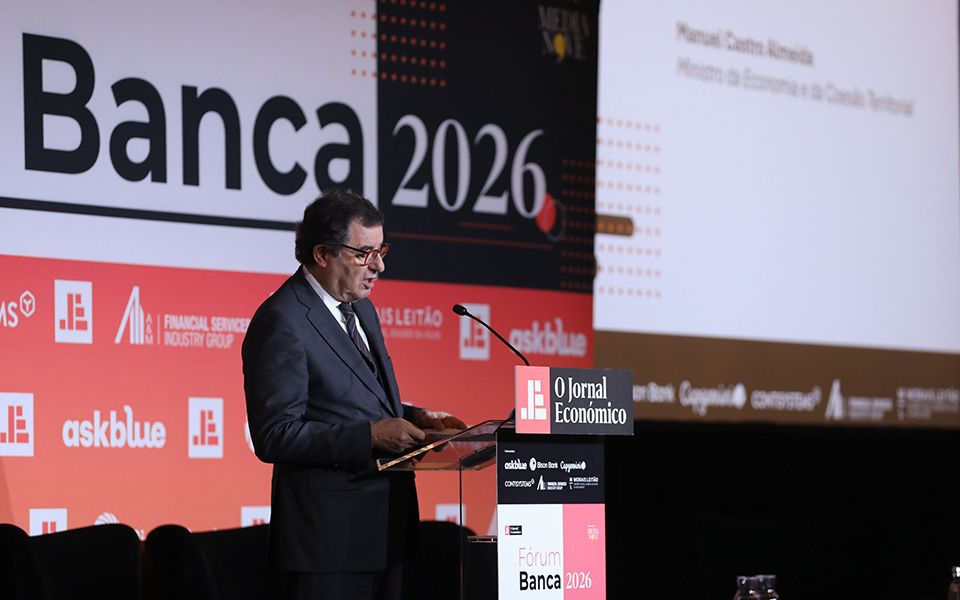
Manuel Castro Almeida warned of an “anomalous situation” in corporate credit at a banking conference in Lisbon and warned that “excessive prudence” could delay economic growth. The bankers have rejected Manuel Castro Almeida’s criticisms. “I always get a little worried when you start aiming for an area where it’s easy to hit,” replied one of the bankers.
Manuel Castro Almeida referred to a “negative side” to national banking in a situation where “the value of companies’ deposits in banks is higher than the value of bank loans to companies.
“This is the first time that this has happened in the last 45 years and it is an anomalous situation that requires consideration”, he said.
The concern to continue reducing the percentage of Non-Performing Loans (NPL) is healthy, but excessive prudence can delay economic growth”, said the minister at the Forum Banca conference, organised by business daily Jornal Económico.
“I can’t find a reason, one single reason that would lead banks to be excessively cautious. The current situation is quite the opposite. When there is so much liquidity, we’re expected to make risky loans. And then, within a few years we’ll have journalists here saying that the banks didn’t know how to manage money and that they were lending to those who couldn’t pay”, said Miguel Maya, leader of BCP”, in irony.
In other words, the banks are damned if they do make lots of loans as being irresponsible, and damned if they don’t for being overly tight and cautious with money.
“The problem is on the demand side. But is this blaming the entrepreneurs? Obviously not. What we have to understand here is why there is no investment. Why are entrepreneurs not investing? Why are companies waiting six months to get a licence allowing them to add an extra shift in a factory?”, he asked.
In other words, it wasn’t the banks that were unwilling to make loans to help companies expand and grow; it was a lack of willingness on the part of entrepreneurs to take out loans in the first place.
Paulo Macedo, CEO of Caixa Geral de Depósitos, said the bank had approved loans but not contracted them, meaning that companies had at their disposal some €45Bn but “for some reason they don’t need it or don’t want it, or our commercial department has been unable to reach them all.”
The new CEO of Santander Portugal, Isabel Guerreiro also considered that there was not the demand at “that intensity that all of us, as Portuguese, would prefer to see”.
She recalled that Portuguese banks offered the lowest spreads to companies. “This shows that there is competition and that there is a desire to lend and support good projects”, she stressed.
The CEO of BPI, João Pedro Oliveira, said that “it is always a bad sign” when criticism is aimed at “sitting ducks”. The BPI leader recalled that banks were “the great solution” during the pandemic. “We gave moratoriums to hundreds of thousands of people, which allowed the economy to continue”, he recalled.
The CEO of Crédito Agrícola, Sérgio Frade, highlighted that all banks would like to grant more credit. However, “taking into account the deleveraging of families and companies, it is natural that banks’ balance sheets reflect the entire economy”.
Pedro Leitão, who is leaving the leadership of Banco Montepio, said that he “completely” refutes the issue that banks are not available to grant credit and rejected the idea of the banks being excessively prudent.
He also recalled that “if the economy does not grow at an ambitious rate, it becomes difficult to create opportunities”.
Source: Jornal Económico; Credits: Jornal Económico