


PwC Barometer of American Companies gauges business confidence for 2026
The mangers of US companies operating in Portugal are largely positive about the Portuguese economy and expect an increase in business in 2026 despite various cross winds such as US tariffs, rising costs, cybersecurity challenges, and continued red tape at a national level.
This was according to José Bizarro Duarte, Partner at PwC Portugal, who presented the results of this year’s ‘Barometer of US Companies in Portugal’ produced annually in cooperation with the American Chamber of Commerce in Portugal (AmCham Portugal).
The report was presented to business leaders at an AmCham Portugal organised event ‘Company development and Portugal-US relations: Prospects and challenges in the current context’ in Lisbon in February.
Naturally, long-term risks at a global level regarding environmental concerns continued to take centre stage as they have for several years. Concerns also focused on technology risks, misinformation, and the adverse consequences of artificial intelligence uptake.
Portugal doing good economically
In the short term, on the positive side, the barometer notes that Portugal is well-respected worldwide, but nevertheless geo-economic confrontations and US tariffs also undermine confidence negatively.
In Portugal, there are also current economic and social risks and which are obviously linked to the challenge of increasing the average salary.
Some 23% of the Portuguese population earns a minimum wage while at the same time Portugal is one of only three countries in the European Union which has grown in GDP terms and has managed to reduce its public debt.
However, the issue of low salaries, a lack of skilled labour, and a perception of Portugal’s economic risk is prevalent.
“We are experiencing a confusing geopolitical situation, different from other times of greater stability”, said José Bizarro Duarte.
“We cannot ignore the different situation in the United States, and the growing consensus in Europe is one of waking up to the need for greater security in several areas, including defence spending,” he added.
And even with Portugal’s growing resilience, it is difficult to navigate in a climate of uncertainty with a lack of confidence for investment while companies need predictability and stability.
The keynote speaker at the event, the Secretary of State for the Economy, João Rui Ferreira, said that with the increasing importance of artificial intelligence, it was “inevitable for companies to adopt it in a bid to increase productivity and competitiveness”.
“Obviously, AI carries a number of risks regarding regulations with a need to invest in people to adopt and make these changes and avoid social disruption”.
Decarbonisation and energy security
Decarbonisation and energy security is also a challenge as Europe recognises the need to go more slowly in its adoption.
Other challenges included funding the national health service, the cost of living crisis due to inflation – all of which worry the Portuguese – as well as the question of uncontrolled immigration.
“The problem of immigration has grown significantly since November, 2025, and today Portugal has 1.5 million immigrants, many of which need to be fully integrated in Portuguese society”, José Duarte noted.
The barometer showed that managers of American companies in Portugal were, despite all the uncertainties, optimistic and positive about Portugal’s economy (51%).
Majority planning to make investments in 2026
When it came to increasing business turnover, 78% predicted it would grow of their companies in 2026 while 22% said it would remain stable.
Not a single US company thought the volume of business would decrease. This meant more investment which generates wealth.
In fact, 66% of American companies in Portugal said they were planning to make new investments in 2026.
This was better than the results from PwC global survey of CEOs which showed only three-in-ten (30%) were confident about revenue growth over the next 12 months—down from 38% in 2025 and 56% in 2022.
The findings suggest that as CEOs navigate a complex operating environment shaped by rapid technological change, geopolitical uncertainty, and economic pressure, many companies have yet to translate investment into consistent financial gains.
Despite this optimism, these companies are aware of Portugal’s challenges regarding competitiveness, as well as more structural problems such as regulatory and bureaucratic complexities, both of which were in the top three (Nº2) concerns held by American companies, the other being energy costs.
Talent attraction problematic
Talent attraction and the need to retain it in Portugal was another concern for American companies.
Cybersecurity was identified as the third major challenge that American companies operating in Portugal have identified.
This concern in Portugal is corroborated by the PwC CEO Survey, an annual study where PwC quizzes CEOs around the world.
As for the issue of adopting AI, although considered good for the Portuguese economy, it was complicated to roll out.
The companies thought changing their businesses to keep pace with technological changes and a capacity for innovation were deemed fundamental by CEOs for the medium and long-term survival of the companies they were running.
Digitalisation in Europe was considered another challenge identified by the managers United States companies in Portugal.
When asked about the relevance of the United States as a world power and its influence in the world, especially since it is competing against the European Union, the opinion from managers in Portugal aligned with the PwC Barometer of American Company Managers and Global Senior Survey suggesting that the US continues to be a vital market for Portugal for trade and investment as its 5th most important trading partner worth around €11Bn in both directions.
Cyberattacks continue to concern
Cyberattacks and cybersecurity, as well as reducing the transition of technology suppliers in non-trustworthy countries, were also concerns. Rising concerns about tariffs and cyber risk added to pressure, as CEOs question whether they were transforming fast enough
This ties into the issue of supply chains and supply chain security, it also links to the issue of the strategic autonomy of the various economic blocs.
And focusing on the issue of artificial intelligence, “I would say that there is a general consensus on the one hand of the imperative to adopt cybersecurity measures, and the imperative to be competitive, but also the challenge of how to do it”, said José Duarte.
Investment in AI
When managers of American companies in Portugal are asked if they are investing in artificial intelligence, ninety-four percent say yes, 54% said it was under development and only 24% said it was still at an initial phase”.
Among the challenges these American companies in Portugal are working on regarding AI such as security, legal and regulations, data privacy, with 55% of companies saying they were developing measures, but 62% found it difficult to attract AI talent.
Some 67% of companies admitted that their companies had not formalised AI processes, and 87% said that their company cultures were not making the adoption of AI easy even though it is imperative for companies.
This is in line with the global outlook where only three-in-ten (30%) CEOs were confident about revenue growth in 2026 as most struggle to turn AI investment into tangible returns and one-in-eight (12%) CEOs believing that AI had delivered both cost and revenue benefits, while companies that have scaled AI with strong foundations are pulling ahead.
Impacts of tariffs
Another result from the barometer, something that’s heavily publicised in daily lives, is the issue of tariffs.
However, managers of American companies in Portugal didn’t perceive it as having a significant impact.
Thirty-four percent of managers said that the impact of tariffs was reduced, and 24% said that there was no impact at all. Therefore, often businesses, the economy, and companies “don’t move at the same pace and sense of urgency reflected by the media and the news”, said José Duarte.
On the other hand, a lack of confidence is hindering investment, partnerships, and growth. It is influencing the costs or continuity of products or services, naturally impacting tariffs with 58% of managers of American companies stated that the impact was reduced or had no impact, but for those which were impacted, “naturally it increases costs and the impact on competitiveness”.
Sustainability
Sustainability has been losing ground on the political agenda. The issue of decarbonisation is obviously a global challenge that continues to affect the entire global community, and “we are all feeling the impacts of climate change, which primarily penalise the poorest countries”. These countries have more difficulty making this transition, have fewer resources, are more exposed to a range of situations, and have less resilience to this climate issue.
“The issue of sustainability strategy is now an indisputable reality, not only among the American companies that were acquired, 82% stating that they are implementing a sustainability strategy, but also showing significant maturity”, explained José Duarte.
“It’s important to note that the set of practices these American companies employ in Portugal are uniform across the groups they belong to, including the United States”, he added.
The high costs and the associated costs for European companies, along with the lack of technology, were also among considerations, but American companies in Portugal believe that despite the turbulence being experienced, their CEOs had a positive outlook regarding the Portuguese economy.
“This is very good, very positive and we must continue to believe in the Portuguese economy, in the capacity of our companies, in the capacity of economic agents, and also in the public sector to continue to promote the country”, concluded José Bizarro Duarte, Partner at PwC.
Text: Chris Graeme; Photo: AmCham Portugal
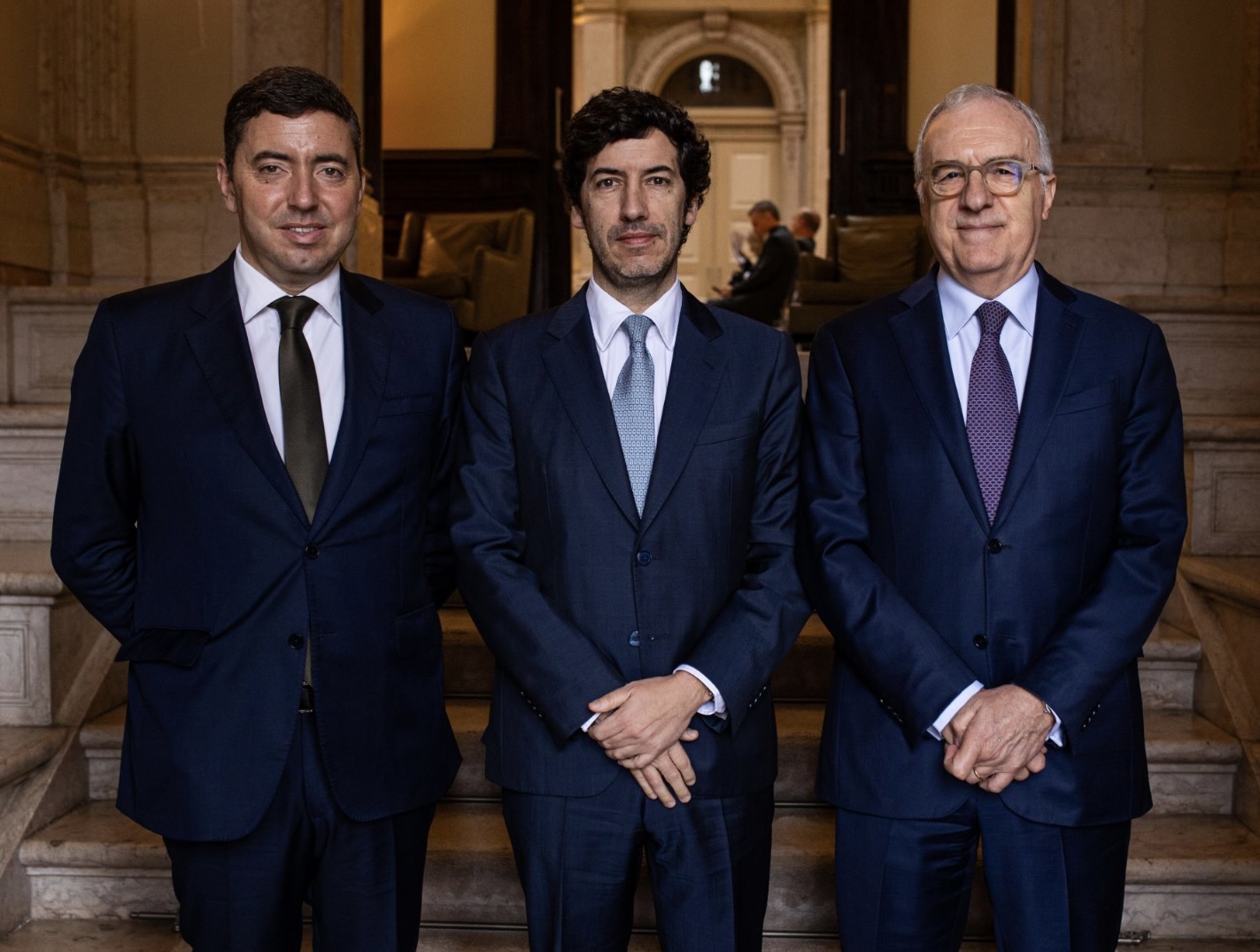
Photo: L-R: José Duarte (PwC), Secretary of the State for the Economy, João Rui Ferreira, Secretary of State for the Economy, and President of AmCham Portugal, António Martins da Costa.