


Great Portuguese founders – the struggle, stories and ambitions that led them to success
Text: Chris Graeme, Photos: Marie Bacelar
What does it take to be a company founder? A mixture of a good ideas, drive, passion, brilliance, resilience and ambition.
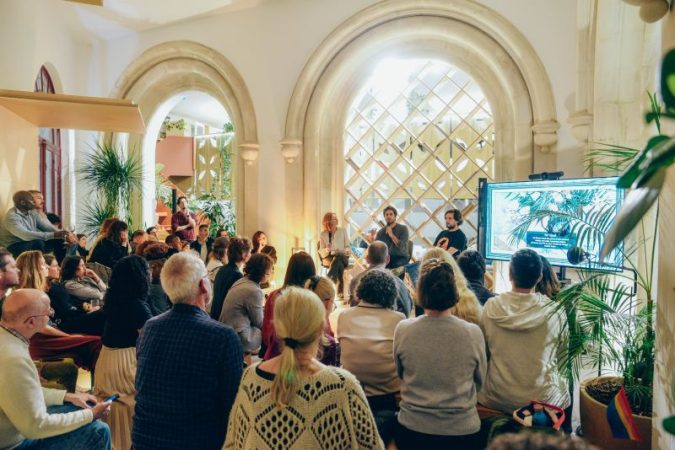
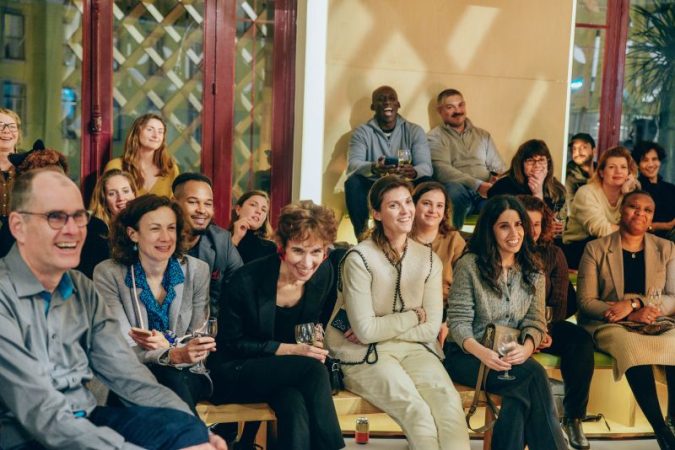
And these qualities were on show at the first RedBridge Cross-Border Community event of the year held on a cold, wet and windy evening in January which nevertheless couldn’t keep a stalwart group of around 100 founders and members interested in hearing from some of the heavyweights of Portugal’s startup ecosystem that strove and won against all the odds.
Telling their larger-than-life stories were Miguel Santo Amaro who co-founded Coverflex – a compensation management platform that allows companies to manage and offer flexible benefits, insurance, and meal allowances in one, fully digital solution, enabling employees to customise their benefits packages—including childcare, education, health, and retirement options—via a card and app to maximise their compensation.
Also there was João Graça, the Portuguese entrepreneur and researcher who is well known as the co-founder and former Chief Technology Officer (CTO) of Unbabel which provides an AI-powered Language Operations (LangOps) platform that combines machine translation with human editing to deliver fast, high-quality, and scalable multilingual content that helps businesses communicate with global customers across customer support, marketing, and technical documentation, supporting over 6,000 language pairs.
But on this night he and other founders were in the beautifully restored neo-Manueline/Gothic surroundings of co-working space Heden Rossio (with which RedBridge has formed a partnership) located in the heart of Lisbon (and the story of Heden deserves a chapter all of its own!)
RedBridge – connecting cross-border tech communities
But first a short introduction to RedBridge, a transatlantic cross-border community linking entrepreneurs in San Francisco, California and Lisbon, comprising startup founders in both cities founded in 2022 by marketing guru Hugo Antonelo (FunnyHow), best-selling author and writer Jonathan Littman, and investment lawyer and entrepreneur Filipa Pinto de Carvalho (co-founder AGPC|HERE Partners).
RedBridge’s vibrant community includes founders, lawyers, artists, authors and journalists, as the latter of which I have become somewhat of a honorary member and regular fixture at their events because they are exciting, informative, and above all, inspiring; meeting the people who dare to take a chance in running with a good idea and making it happen!
The aim of the meetings, apart from spotlighting these amazing and courageous founders, is to connect communities, build bridges (hence the brand’s use of the San Francisco/Lisbon April 25 bridge (by the same architects’ studio, by the way), and to welcome newcomers and connect them with the local community and share perspectives and experiences. A truly pioneering group.
Lászlo Varga – a co-working pioneer in Lisbon
Starting with László Varga, who together with Manuel Bastos formed Heden Coworking, who have led the company’s expansion in Portugal since 2018.
Hungarian László is an architect and entrepreneur with experience in design, development, and real estate operations while Manuel has had wide experience in hospitality and F&B startups in California, and this space in Rossio was their fourth co-working project.
László thinks big, and some of his projects that started out as relatively humble €600,000 refits ended up as almost urban regenerative and city planning projects of €16 million or more involving multiple buildings as was the case for a Google project.
“I’m not really a corporate guy, but I went to Silicon Valley to work for Google as Campus Architect” he says, and also taught at Stamford University.
“I was working in an ecosystem environment and in many ways it’s a lot like Lisbon. Then me and my business partner Manuel came up with the idea of starting a co-working or even a co-living project. We went for co-working”, he outlined.
Deciding to start in Lisbon, they began with a very humble 500 square metres space in a basement and today now have six co-working spaces dotted around Lisbon in the best or most central neighborhoods taking into account the 15-minute city vision, all of the spaces exercising a sustainable approach that concerns the environment, economy and community.
Granter ai – taking the migraine out of EU funding applications
Next up was were the founders of Granter ai, the ‘two Bernardos’, Bernardo Seixas (CEO) and Bernardo Tavares (CTO).
Founded in 2023, this Portuguese startup, which provides an AI-powered platform for finding and managing grant funding, is based in Lisbon. The founders are known for driving the company’s goal to simplify, automate, and democratize access to European grants, planning to offer a now-fee, no result philosophy.
The idea – based on their own frustrating personal experiences dealing with all the complexities and bureaucracy of applying for EU grants – was to design an AI-powered platform designed to make public funding radically more accessible to startups and SMEs.
“As someone who’s done a lot of projects that require public funding, I know that this is one of the very few AI companies that actually have incredible value in the real world,” said Seixas.
Today, Granter is helping around 1,000 potentially paying clients signed up to the platform – a number boosted by its exposure at this year’s Web Summit where it won the 2025 PITCH out of 2,725 startups!
“We were on the point of quitting, and all of a sudden we won the competition” he said explaining the background to the company.
“The European Union awarded €285Bn in grants in 2025 and yet most companies missed out, not because they were rejected, but because they got buried in bureaucracy or because they didn’t even know the grants existed because would-be applicants for funding need to be constantly searching in outdated government websites and wading through reams of rules and regulations, and then spend up to 50 hours writing ONE application!”, he said.
“Now, imagine doing this without any certainty of success several times a year – it’s basically a full-time job”, he said, adding that most end up being a “complete waste of time and money (If the company is hiring consultants):
“We at Granter have created the world’s first AI consultant, a vertical AI agent that handles everything,” he affirmed.
And today, it is already trusted by some of the biggest companies in Portugal, like Sonae, Fidelidade, Galp, the Portuguese Navy, among many others.

Coverflex – delivering employee benefits
Next up was the founder and CEO of Coverflex – which is one of the most important and successful Portuguese startups – Miguel Santo Amaro, A man who is only 37 but who with a team of five co-founders (Miguel Santo Amaro (CEO), Nuno Pinto (previously involved with Kide), Rui Carvalho (COO), Luís Rocha (CMO), and Tiago Fernandes (CTO))
Together, they came up with an all-in-one, digital compensation management platform that helps companies design, manage, and deliver employee benefits, insurance, and meal allowances, beyond salaries.
The audience also heard from João Graça, the co-founder with Vasco Pedro and CTO of Unbabel, the AI-powered Language Operations platform where he served as CTO since its inception in 2013 – one of the first Portuguese startups to be incubated at San Francisco’s Y-Combinator which created a new model for funding early stage startups, investing in a large number of startups four times a year.
Uniplaces – a solution for mid-to-long-term rentals

Miguel Santo Amaro actually started out with Uniplaces, a major online marketplace designed to help students, young professionals, and digital nomads find mid-to-long-term accommodation.
Founded in 2013 together with Ben Grech, Mariano Kostelec, it provides a trusted, digital platform for renting verified rooms, studios, and apartments without the need for traditional, bureaucratic, and in-person renting hassles. Today, that company has making around €100 million in revenues.
“It’s a weird moment because I literally built this office (Largo Duque do Cadaval No17, Rossio, Lisbon) 10 years ago”.
The co-working building where we are assembled back then was Uniplaces HQ. “I was a graduate in the US, started out in London and then came to Lisbon said the Coverflex founder who originally hails from Porto.
“At that time Lisbon wasn’t really a place to come. I met Brian Chesky the founder of Airbnb when he was pretty much no-one back then. I got really engaged with that and thought that in Europe mid-to-long-term rentals was actually a much more interesting opportunity than short-term rentals. I never thought a ‘bedding business’ would become that much a deal”, he says recalling those times which sparked his idea for Uniplaces.
João Graça recalls those times too. “We were building Unbabel a the time and suddenly it was a really exciting time to be in Lisbon and we felt we could build another Silicon Valley.”
“RedBridge has been a great inspiration for us because a lot of founders asked where could we build another Silicon Valley somewhere else, and Lisbon seemed the place although it was 50% a failure because you just can’t replicate Silicon Valley”, he reflected.
He says that today startup founders have to go abroad to raise money because “there’s little investment in Portugal”.
“You can build a startup in Portugal but the market is not big enough for growth. In Lisbon I feel like a big fish in a small pond, but every time I go to San Francisco I realise how small we are,” he reflected, adding “Portugal can be a test market, but don’t think you’re going to achieve anything out-of-the-box, although today it is easier since there are a lot more investors now in the ecosystem and they have connections with bigger investors elsewhere.”
Today, João Graça has a new project called Soko together with co-founder João Matos Albino – a local discovery platform that helps people find and share what’s happening around them—from small neighbourhood activities to community events—so they can connect with others nearby.
“I looked at my own experience. I was born and raised in Lisbon and, luckily, I don’t struggle with belonging thanks to incredible friends and family. And yet, I still struggle with local discovery.
Whenever I ask what to do with my daughters on the weekend, I get the same great recommendations—the Oceanarium, the Science Museum—which we’ve done dozens of times. What I miss is the cupcake masterclass someone is organising in the park near my home.
The core problem is that local information—because of its limited scope and reach—is extremely fragmented or not on the web at all. Search engines simply can’t find it, which makes it invisible.
Soko plans to change all that. “We believe that if we can create a simple way to share these micro-events and reach the right audience, we can help recreate behaviours we once took for granted—like kids playing together on the street. Imagine how easy it could be for parents to organise a football match in the park and reach other parents nearby in a non-intrusive way”.