


Mercosur Accord – the winners and losers in Portugal
After 25 years of talks, the EU signed the EU-Mercosur trade deal on Saturday, creating a 700 million-person free-trade area.
Ratification is still pending, however, with the European Parliament set for a heated debate.
EU chief Ursula von der Leyen on Saturday hailed the choosing of “fair trade over tariffs” as the European bloc signed a major trade deal with South America’s Mercosur nations that has been 25 years in the making.
“We choose fair trade over tariffs, we chose a productive long-term partnership over isolation,” Von der Leyen said at the ceremony in Asuncion, Paraguay.
But how will the accord, which will bring changes to applied tariffs, impact Portugal where sectors such as wine, olive oil and cheeses are expected to make gains while livestock and rice farmers fear losing out.
Trade between Portugal and the Mercosur countries stands at about €8.5Bn, with Brazil the main destination of Portuguese exports in these two farming categories.
European Council head and former Portuguese Prime Minister Antonio Costa said the deal sent “a message of defense of free trade, based on rules, of multilateralism and international law as the basis for relations between countries and regions.” He said it stood in contrast to “the use of trade as a geopolitical weapon.”
Within the broader scope, the EU-Mercosur deal is contentious due to fears of increased Amazon deforestation from cheaper agricultural imports (especially beef), risks to EU farmers from unfair competition and lower standards, and concerns over human rights and climate commitments, making it a major political hurdle with opposition from farmers, environmental groups, and some EU nations like France and certain sectors in Portugal.
While the opportunities for growth in the farming sector in Portugal from the deal are not likely to be significant, unfair competition and pressure on local producers are.
Total trade between Portugal and Mercosur currently amounts to around €8.5Bn, but among the four countries (Argentina, Brazil, Uruguay and Paraguay), the Brazilian market — due to the long bilateral relationship — is the main destination for the sale of Portuguese goods.
From January to November 2025, Portugal exported €981 million worth of goods to the Brazilian market, although this represents a drop compared to the €1,058 exported in the same period, according to Portugal’s National Statistics Institute (INE).
In 2024, Brazil occupied 11th place in export countries from Portugal while Argentina was down at 64th place, Uruguay at 103 and Paraguay at 104.
“The opportunities are very evident for producers of wine, olive oil, fruits or cheeses, for example, since it is a huge expansion of the export market, in a context of reduced customs tariffs,” the Secretary-General of the Confederation of Portuguese Farmers (CAP), Luís Mira, told the online news source ECO.
Currently, exports of wine from the EU to Mercosur face tariffs of 27%, sparking wines and champagnes between 20-35%, chocolate 20% while spirits between 20-35%.
In Portugal the greatest number of exporters to Mercosur are in the North, followed by the Lisbon region and Tagus Valley.
Despite a period of turbulence, the Portuguese wine sector – which in 2024 had 1,454 exporters, or 6.4% of the total in Portugal, so Portugal will clearly benefit from this accord.
From January to November, 2024, the Brazilians bought €80 million of Portuguese wine, making it the second main destination for Portuguese wines, excluding port wines.
The other Mercosur countries do not buy a very relevant amount of Portuguese wines by comparison.
“The agreement is very positive, because it opens doors and facilitates entry into a market where Portugal already has a strong presence, namely Brazil,” says Frederico Falcão, president of ViniPortugal, noting that “regions such as Alentejo, Vinhos Verdes, Douro may benefit more because they already have a higher volume of exports to Brazil.”
However, Portugal is up against competition from much larger wine producing markets such as Spain, Italy and France
The four South American countries also represent a market opportunity for Portugal’s olive oil producers since it is already the sixth largest exporter worldwide and the fourth in Europe, but behind Spain, Italy and Greece.
In 2024, overseas sales exceeded €1Bn and a 2% market share of Portugal’s total international trade with 627 Portuguese companies selling it overtness, but 4.3% represented 82.2% of the total value exported.
Portugal’s exports of olive oil to the four Mercosur countries stood at €274 million according to data from the EU’s statistics agency Eurostat and not surprisingly from the four South American countries, the Brazilian market is by far the most important for Portugal, representing 99% of all Portuguese olive oil exports to South America.
The General-Secretary of the House of Olive Oil, Mariana Matos said the “immediate impact on sales to Mercosur countries (other than Brazil) would be relatively residual ”.
Great news for industry
The Mercosur agreement is great news, however, for Portuguese metals sector according to the President of Metal Portugal (AIMMAP), Rafael Campos Pereira who believes that the accord could be relevant in a world increasingly polarised by the USA and China.
Brazil occupies the top 15 (13th place) of the main destinations worldwide of Portuguese goods from the metals sector and in the first 10 months of 2024 exports had grown by 14% to €277 million.
Argentina, Uruguay and Paraguay represented only €27 million worth of metal machinery, electrical devices and metallurgical goods from Portugal. That said, Portugal faces stiff competition from Germany selling €1.2Bn in iron, steel and metal products, €5.3Bn in machinery and electrical equipment and €2.3Bn in transport equipment.
Woes for some farming products
While the Mercosul agreement could provide an opportunity to reduce the current annual farming trade deficit by €517 million between Portugal and Mercosur, in some specific sectors like rice and meat, the accord is alarming some farmers.
According to a study coordinated by Rasma Kaskina, from the External Policies Analysis and Support Unit of the European Parliament, this means, however, that for products where both Mercosur and the European Union have a comparative advantage – such as food, timber, live animals and animal products – there is greater pressure on European countries.
Despite considering that the agreement will have an relevant impact for Portugal in sectors such as wine, olive oil, or fruit, regarding imports, the CAP warns about some “potentially sensitive” products like beef, pork, poultry, rice and honey.
The rules, once they come into force, point to a total of 99,000 tons of beef entering the European Union at a 7.5% tariff – which rises to 180,000 tons for poultry meat at a zero tariff.
According to data from the Commission, Mercosur’s total beef production amounts to 15.5 million tons, of which: 11.2 million from Brazil, 3.3 million from Argentina, 0.6 million from Uruguay and 0.5 million from Paraguay.
The Portuguese Association of Meat Industries (APIC) says this means that the market will be “flooded by these Mercosur products at a cheap price.”
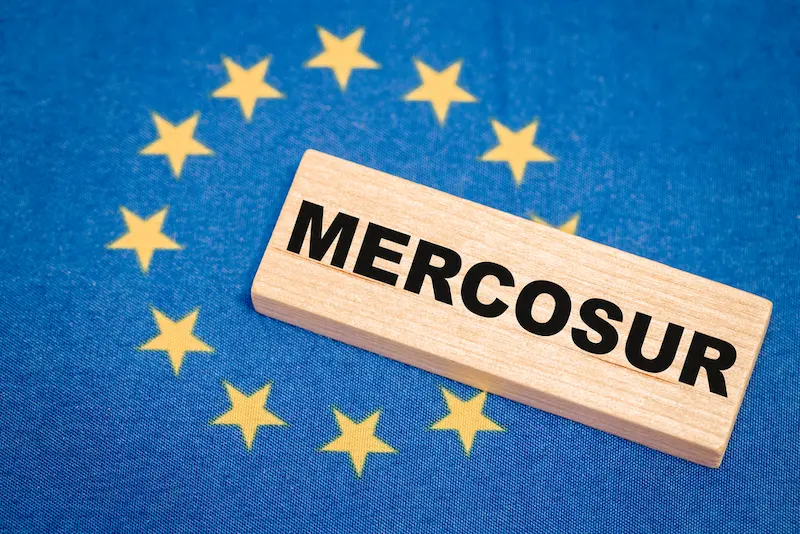
Image: Depositphotos