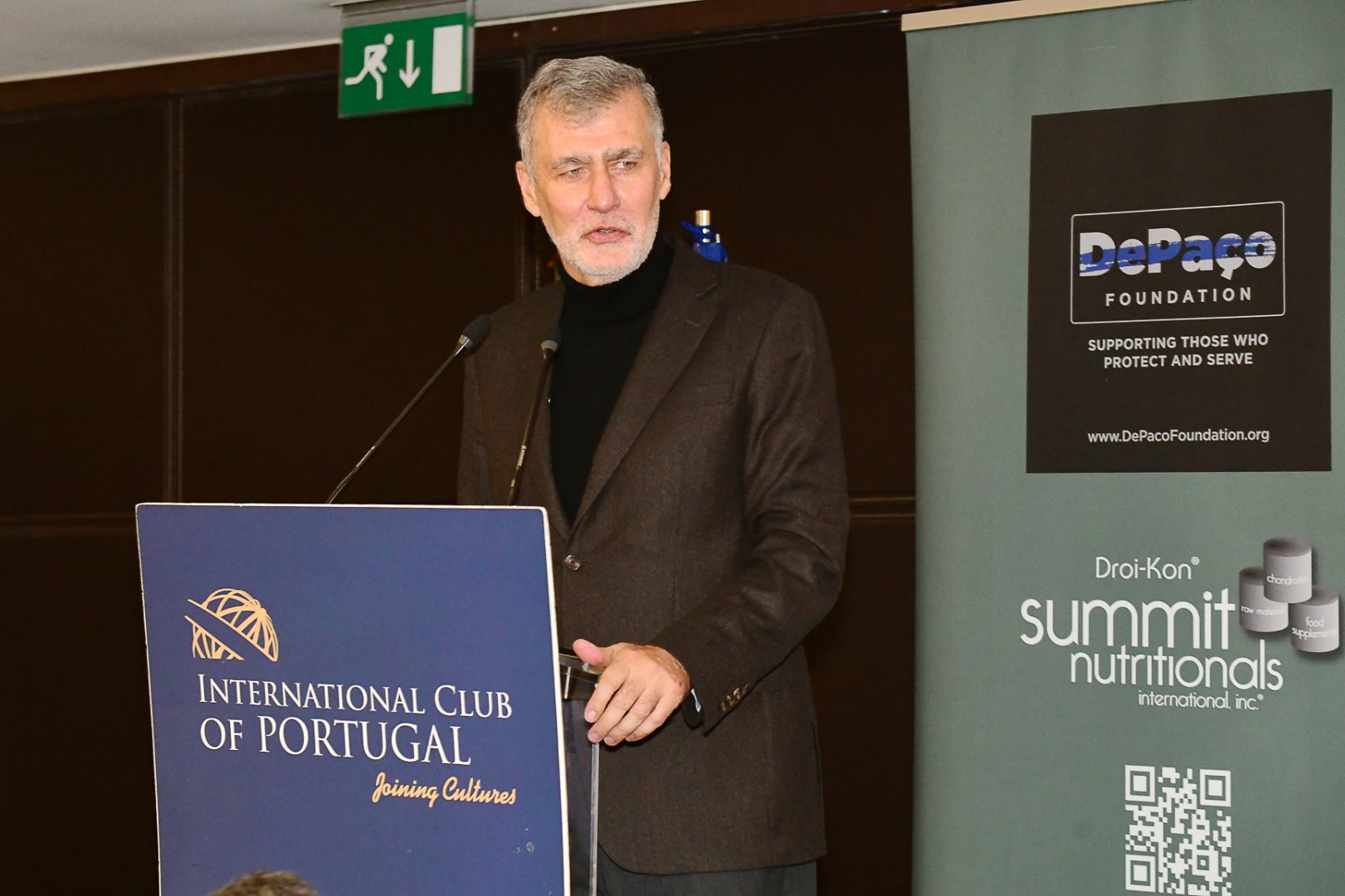



Standing united in Europe and Portugal and containing Russia
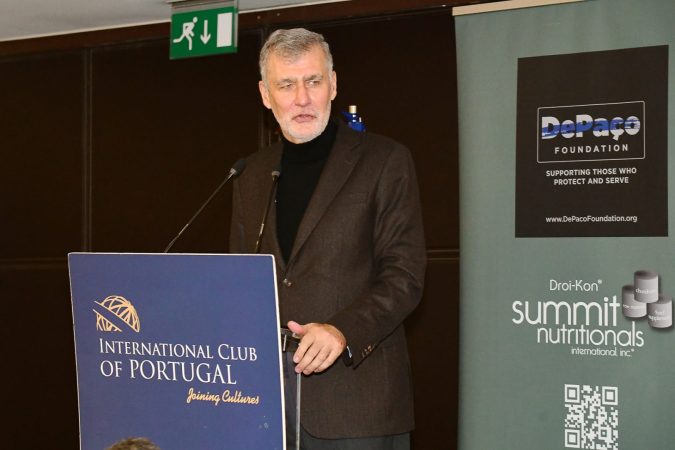
“We have to keep the Russians contained within their borders.” – Defence expert and presidential hopeful Admiral Henrique Gouveia e Melo at a lunch organised by the International Club of Portugal.
Text: Chris Graeme; Photos: Fernando Bento (ICPT)
“We are living in a particularly difficult time in Europe and I am truly worried about the international situation”.
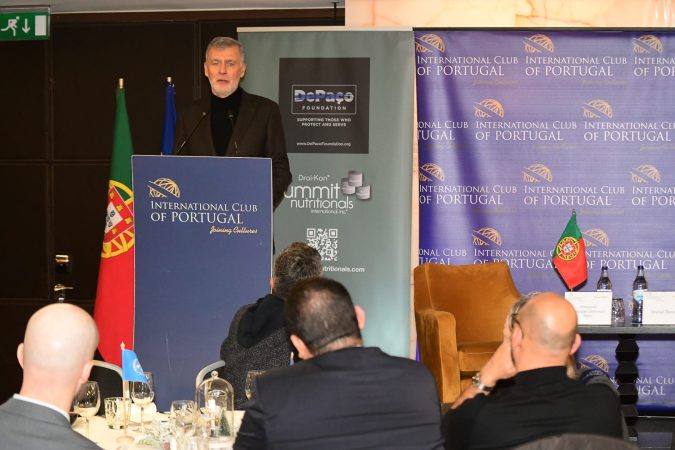
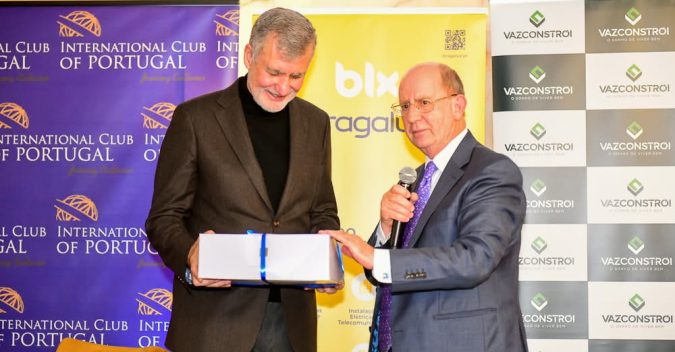
This was how retired Portuguese Admiral Henrique Gouveia e Melo opened his address to business leaders at a lunch organised by the International Club of Portugal (ICPT) at a Lisbon hotel on December 18.
It was the last lunch held by the ICPT – a business and associative club that joins cultures, explores ideas, and unites nationalities and that next year celebrates its 20th anniversary – in 2026, and was not so much a campaign speech from the independent presidential hopeful but a warning that Europe had to prepare for its defence and could no longer rely on the United States to protect it and foot the bill for that protection.
And this was not a dig at the current White House incumbent, Donald Trump; rather a reality that has been a long time coming, going back to the Obama years when it was made clear that Europe needed to make a greater contribution to its defence.
The speech was also timely, at a juncture when Portugal’s government, through its Ministry of Defence, has signed up to a €12.5 million investment in tactical defence vehicles while Portugal decided this year to beef up its defence spending, bringing forward its target to reach 2% of GDP with an additional €1.3Bn investment, focusing on equipment, infrastructure, cyber defense, and Ukraine support, marking the biggest jump in over a decade to meet NATO goals and boost national capabilities.
“We are living through a particularly difficult time in Europe, but we are living through a time of transition in the world system. And this moment may have implications for Portugal”, said the admiral.
And continued: “As we are gathered here today, the future of Ukraine and Europe are being discussed. The worst thing that can happen to us right now is for the Russian Federation to be free of Ukraine (meaning a dubious and weak peace deal), and be able to make its war machine available to any other points in Europe that will certainly involve NATO”, he warned
In June this year the gloves were finally off when Russian President Vladimir Putin admitted what he had thought all along-. “All of Ukraine is ours”, according to an article published by the Atlantic Council.
The Kremlin leader’s revealing statement is an indication of the seemingly increasingly confident mood in Moscow as Russia continues to make slow but steady progress on the Ukrainian battlefield against a backdrop of deepening Western disunity over financial and military hardware support.
But is it really so? Is it a desperate assertion by an old man who knows his window of opportunity to take Ukraine is running out, but needs a peace deal to buy time to regroup, rearm and build up financial reserves for a second bite at the cherry? Is this deal a replay of Munich 1938?
It also serves as a timely reminder of a possibly Russian neo-imperialism that could be driving Europe’s largest invasion since World War II.
Or, on the other hand, it might just be about having a buffer state between it and NATO countries as the autocrat pledged in his annual end of year televised broadcast when he said: “If the West respects us then there will be no more need for Special Military Operations”.
The retired admiral outlined three possibilities: One of them was that the Russian Federation would not keep to its borders and invade Moldova, for example, or that it would make a calculated error and invade a NATO member state (such as Lithuania) where eventually NATO would have to react as a whole, triggering Article 5 of the NATO treaty. “There we would have a problem on a global level”, he warned.
But there is no guarantee that NATO would react in one voice. Imagine this scenario: Russia moves to connect Kaliningrad by attacking the Baltic states — using the same logic it used to seize Crimea. What happens next?
Many assume NATO would instantly mobilise a massive army and crush the invasion. But that’s not how it works. Article 5 is not a magic switch that automatically unleashes NATO’s full military might. It’s a political decision — debated, negotiated, and voted on by 32 separate governments.
And here’s the reality: it has been invoked only once in NATO’s entire history — after 9/11 — and even then, the alliance managed to collectively gather around 100,000 troops. Russia today fields close to 2 million. And it’s not even sure if Hungary and Slovakia would agree.
The second possibility is that Russia invades another country and calculates that the Unites States is so uncoupled from Europe as its attentions are focused on China and now Venezuela and Syria that it does nothing and that the European NATO countries are so disunited that they end up paralyzed. “If that happens, then it might as well be the end of NATO”, said the admiral.
In both cases it would be hauntingly reminiscent of 1938 and the Sudetenland just a a crisis over the Suwalki Gap (a 100km strip of land linking Poland and Lithuania and the other Baltic states and flanked by Russia and Bielorussia) could end up being a reflection of Danzig and the Polish Corridor in 1938 and 1939.
In such a situation it would inevitably be, in the words of the admiral: “each for his own”.
But a third scenario, which would be most advantageous for Europe says the admiral, would be to create a rapid deterrent.
But with nuclear weapons, don’t we have such a deterrent in any case, and how likely really is an open land war in Europe in an age of a different kind of war – one that aims to sow seeds of disunity and disharmony through the media, social media, propaganda, sabotage, and cyber threats?
And does anyone really truthfully believe that Russia has the money to pursue a continental adventure in Europe when it can’t even take Ukraine?
Breaking this down, Russia probably has around one more year to win this war and turn Ukraine into a puppet rump state like Bielorussia.
While the Russian economy had shown surprising resilience up until 2024 driven by a war economy and considerable reserves in its sovereign wealth fund, the war economy is not sustainable and the wealth fund is running down.
With inflation at 20% and with its banking system in serious problems with high levels of NPLs and NPEs, these would all but collapse were it not for Russian government bailouts from the wealth fund.
Russia is also facing long-term issues such as labour shortages, factories unable to pay wages, a record default on credit cards, and Russians removing as much cash as they legally can because they no longer trust the banks to safeguard their money.
And outside of the two main cities of Moscow and St.Petersburg shortages of foodstuffs are reported in the press with widespread inflation hitting basic items.
This is not like the Great Patriotic War in 1941 when Russia’s survival was at stake. The Russians would not support and take kindly to a general mobilisation over Ukraine or another Eastern European country.
In short, Russia doesn’t have the manpower, support of its population or funds to prosecute a wider war in Europe, and there is now no guarantee that Bielorussia would support it, while China is probably unlikely to support its convenience ally when the money runs out either. On the contrary, it has considerable territorial intentions in the Russian Far East for lands which it historically believes belong to it.
The admiral believes we should invest more in our own defences and create a deterrent, and if only not to rely on the US perhaps we should.
But also we should not over-blow the threat from Russia which, I believe, is perilously close to a 1916-1917 scenario of internal collapse at home and lack of willingness on the front line to continue on indefinitely as the news spreads that Russia’s government doesn’t have the money now to pay its troops what had been promised, and which was, after all, the main motivation for them signing up for the war in the first place.
But as Admiral Henrique Gouveia e Melo says, “even the deterrent path has to be planned with a clear head.
“Even this path has to be planned and intelligently. Today, in our national landscape, investments in the Armed Forces and in our defence are being discussed but there is no architectural plan, much less an engineering plan, but they (the armed forces) have already gone shopping”, he said.
“That is, we want to build a house without architecture, without engineering, but they have already gone to buy building materials. This is a serious mistake for me, because this architectural and engineering plan, which is called the Strategic Concept of National Defence and the Strategic Military Concept could be revised in record time, in two or three months, and would be enough to have a clearer idea of what we want for our immediate, medium and long-term future” stressed the admiral.
Portugal, he said, was a country that did everything “on the hoof”, an improviser. Yet a country that didn’t plan anything also leaves it susceptible to the policies of others that don’t have this habit of improvisation and (lack of) planning, and therefore have the capacity to end up influencing the destinies of others, and “naturally, the destination of Portugal”.
“We will be pumping €6Bn into the industrial and technological centres of other countries (making arms) thereby making the separation between the industrial and technology centres and the economies of these respective more advanced countries and the less advanced ones in Europe even greater,” said Admiral Henrique Gouveia e Melo adding that this increased the differences between North and South and in this case, including Portugal.
Why was this a concern? Because there was no such plan, neither architecture nor engineering, leaving Europe wide open to making a mistake when there is limited time to react.
“The Russian Federation currently has three years of opportunity and this window of opportunity is closing. Why is it closing? If the Trump administration changes, the window of opportunity has closed and therefore the riskiest period is the next three years”, said. (This sounds hauntingly like the German Imperial High Command belief that Germany had to attack Russia before 1917 or it would be ready technologically to attack it and win)
But Europe just needs to give the weapons Ukraine needs to hold the front line for another 12 months and I believe she will prevail. I don’t think Russia has more than that, let alone three years. The €90Bn loan announced last week will help, and maybe it might just be enough.
What we don’t need is the US bullying Ukraine into signing a detrimental peace deal that surrenders its land and only makes Russia’s bid for a second invasion five or 10 years down the line inevitable. And what is Portugal doing? In the admiral’s opinion it is acquiring military equipment that will not be available in less than six years; that is, when it no longer serves any purpose in terms of deterrence value.
“Instead of putting in everything we have and reinforcing it at an operational moment, we are taking the path of a vain hope that the Russian Federation will be friendly while it hopes that Europe will not rearm.
That does not seem very logical in a chess player like Russia. I think we will all do very badly. And the worst thing is that fear and paralysis leads us to fight”, warned the independent non-party affiliated candidate for the presidential elections in January next year, Henrique Gouveia e Melo.
As for the rest, he calls for all to be united, in a logic without ideologies and party factionalism, but instead all united in favour of Portugal and a common project because “we’re all in the one boat and it’s only boat that we have”.
They say “cometh the moment cometh the man”. If we are heading towards some kind of war with Russia, which they say they don’t desire but are ready for if Europe want’s it, (They certainly are not ready whatever bluff they put on), perhaps he is the right man to be President of Portugal for the next five years.
At the end of the lunch I ask the admiral if that with all this talking up of war by the UK and NATO leaders are we not risking making it a reality.
The admiral is adamant: “We have to keep the Russians contained within their borders so they stay there and don’t even entertain the idea of expansion”.
That’s what France and England did regarding Imperial Germany in the two decades leading up to World War I. The logic of encirclement was the same, but it didn’t prevent war from breaking out in Europe in 2014. Is there any reason to think it will this time? All it requires is a powder keg somewhere in the world.
Let’s hope that it doesn’t come to war with Russia, but we must be prepared for any eventuality all the same, and while we are not, Poland certainly is.
The end of a sober speech was lightened by some musical entertainments and the distribution of chocolates and a chocolate Father Christmas with a surprise Chitty, Chitty Bang Bang! style performance from singer Eva Stuart.