


The Lone Star wizard transforms Novobanco from the ugly duckling to the beautiful swan
When the Banco Espírito Santo (BES) led by Ricardo Salgado ignominiously collapsed in 2014, leaving its major French investor Crédit Agricole with nothing, few could have imagined that its successor bank would one day form part of their local competitors, BPCE.
Text: David Sampson: Images: Novobanco/Lusa
BES had been nationalised in 1975, but on its privatisation some 15 years later, the Espírito Santo family was able to take back control. The family was then supported by foreign investors such as Crédit Agricole, but it was always short of capital to finance the projects of both the family and the bank’s clients. In the middle of the post-2008 crisis, the government offered financial support to all the Portuguese banks, but BES preferred to raise additional capital from its shareholders because it did not want any government checks on its accounts.
The situation got sharply worse in 2013/4 when the Bank of Portugal insisted on a clear division between the bank and the family’s property interests. Again the bank raised more capital, but shortly afterwards it had to ask the Portuguese state to bail it out. The then right-wing government refused and opted instead to set up a new bank called Novobanco, to which the viable part of BES was transferred. The toxic assets and all the bond holders were left in the bankrupt old bank.
A coverup?
The cost to the public exchequer was covered up by using the so-called Resolution Fund as the sole shareholder of the new bank. The Fund had been set up in 2012 with the mission of providing financial support for any bank in which the Bank of Portugal might intervene. The money for the Fund was to be contributed by all the banks in Portugal, but when BES collapsed in 2014, the Fund’s own resources amounted to only €377 million. The solution eventually agreed by the government, the Bank of Portugal and other banks in Portugal was that the Fund would contribute €365 million, the other banks would make a loan of €700 million and the government would lend to the Fund the balance it needed, which amounted to €3,900 million. The loan was to be repaid over 40 years. This scheme allowed the government to claim that the taxpayers were not being called upon to contribute to the bail out.
Attempts to sell Novobanco
The government’s intention was to sell Novobanco as soon as possible, but as Mario Centeno, the former Finance Minister and later the head of the Bank of Portugal, said in a recent interview, “It was no surprise that the first attempt to sell the bank failed in 2015. Nobody wanted to buy an under-capitalised bank which was full of problematic assets at a price far above the amount which was injected at the moment of resolution. Novobanco was new, but it inherited old problems and it had many complex challenges to deal with. It needed to be made into a good bank”.
In 2017, the government made a second attempt to sell, and finally agreed to sell 75% to Lone Star, an American vulture fund. Lone Star agreed to put an additional €1,000 million of extra capital into Novobanco on the basis that the Resolution Fund would continue to be responsible for contingent losses, which could amount to a maximum of €3,890 million.
According to Centeno, the sale resulted from “a legal requirement and was the way out which was found, though it was difficult and with risks for the Resolution Fund, in the context of how the question of contingent capital was handled”. He recognised that the moment to intervene in the bank was when it declined to take up the public capital offered in 2012. “The financial means were then available, there was the institutional framework in place and everyone in the sector agreed how important it was for us to come out of the financial crisis with an effective financial system. But that didn’t happen, and when the bank had to be rescued, it had in fact a portfolio of lower quality assets.”
Lone Star takes control
After an open tender and a competitive bidding process, Lone Star took control of Novobanco in October 2017 and started clearing out all the dead wood. It put the bad debts into various Non-Performing Loan bundles and offered them for sale on the international market. They were sold to the highest bidder and it is not clear what checks were made on who was buying or on what information – privileged or otherwise. The goal was to turn the bank into a saleable asset as soon as possible. After all, the clear aim of equity funds like Lone Star is to come in, sort out and get out.
Two parliamentary inquiries
The first parliamentary inquiry into the collapse of BES during 2014 and 2015 was mostly concerned with investigating the family and financial structure of the Espírito Santos, what caused the collapse of BES, and the actions taken or not taken by the Bank of Portugal, as the supervisory authority. It examined the already known cases of improper conduct by Ricardo Salgado and others, and heard from those who had complained about his conduct.
The second inquiry followed after lurid reports started to appear in the press that portfolios of thousands of properties were being sold off at bargain prices. In one case, it was reported that properties standing in the books of Novobanco at €631 million were sold for €364 million, and that a large proportion of the price was then lent by the bank to the purchaser under what is known as Vendor
Finance
The inquiry this time was into the losses of Novobanco which were borne by the Resolution Fund. Between March and June 2021, the Commission heard 56 witnesses. One of the last witnesses was Fernando Ulrich, who led the BPI Bank until it was acquired by La Caixa. He thought that any mismanagement by the directors of Novobanco had led to only minor losses. “My impression”, he said, “is that a very substantial proportion of the €16.4Bn that the combination of BES and Novobanco needed to cover their losses was due to decisions taken before August 2014”, the month of the resolution of BES and the creation of Novobanco.
He went on to criticise the supervisory model at the European level because it “obliged both good and bad banks to sell assets in order to achieve lower bad debt ratios”, which meant that outside funds and not the banks profited from any recovery in these assets. BPI considered making an offer to buy Novobanco in 2016, but he said, “I consider that Novobanco was well sold”. It was another thing to know if it was sold at the right time and “it would probably have been better if it had not been necessary for the bank to sell assets”. When challenged about the sale of assets, António Ramalho, the then CEO of Novobanco, replied that the sale was designed to reap the benefit of the recovery in the Portuguese real estate market.
Carlos Costa, the former president of the Bank of Portugal, again defended his record against criticisms of the bank’s failure to act earlier and of the whole resolution process. In his opinion, “the cost of taking action was incomparably less than the cost of doing nothing, even leaving out of the account the systemic risks. The whole process”, he said, “was transparent and competitive. It was like selling a basket of apples where some had gone bad, to avoid a situation where the whole basket had gone bad”.
It became clear at the hearings that once Novobanco was sold to Lone Star, there was little anyone could do to reduce the total cost to the Resolution Fund, and behind it the Portuguese taxpayer. One way or the other, the result of the government’s decision not to bail out BES or nationalise it, but to try to create a new bank on the ruins of the old, was that the state had to pick up the full tab for the losses already incurred before Novobanco came into existence.
The wizard does his magic
Mark Bourke has been CEO of Novobanco since 2022. The on-line newspaper ECO recently described how, over the last two years, the “Irishman travelled to the four corners of the world with the mission of selling Novobanco and the image of Portugal as a good investment destination. He had more than 400 meetings with investors from Europe, the United States and the Middle East”.
In 2018, Bourke was recognised by the Irish Times as the best Chief Financial Officer (CFO) in Ireland after restoring Allied Irish Banks and floating it on the Stock Exchange. He was then recruited as CFO of Novobanco and came to Lisbon in 2019, where the objective was to follow a similar path. By the time he was appointed CEO, the heavy labour of restructuring had been completed and all the losses were in the past. He was therefore able to focus on selling the bank either through floating the bank on the Stock
Exchange or by finding a buyer
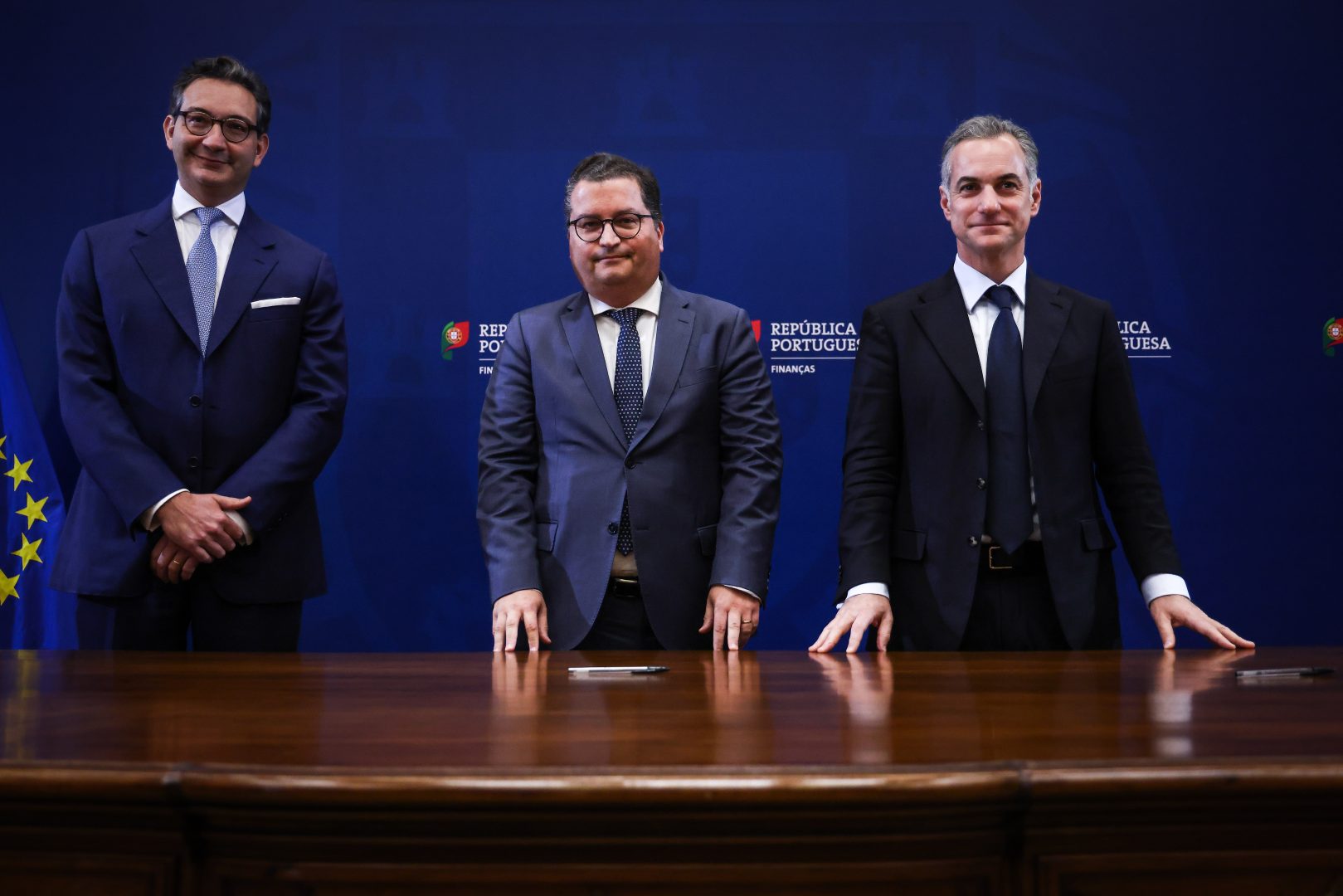
In June, it was announced that Lone Star had agreed to sell Novobanco to the French Bank BPCE, which outbid the Spanish Caixa Bank. BPCE agreed to pay €6,400 million for Novobanco, a far higher price than anyone had previously imagined possible. Seventy-five percent of this price will go to Lone Star. Miranda Sarmento, the Portuguese Finance Minister, commented that through the sale of shares and dividends to be received, the state will recover nearly €2,000 million of the public funds injected into Novobanco. He was also clearly pleased that the buyer was a French rather than a Spanish bank because it avoids “unnecessary geographic concentration”.
The purchase price represents about nine times the annual profits of Novobanco and is the largest cross-border transaction in the last 10 years. Nicolas Namias, the CEO of BPCE, which was created through a mega bank merger in France in 2009 of Banque Populaire and the Caisse D’Epargne, stated that his bank wants to be a long-term partner in the Portuguese economy. “We will be long-term investors. In fact we are not investors; we see Novobanco as part of a big group.”
The power of capital and the lessons to be learnt
During the course of the commission hearings, the underlying problems of Portugal had been painfully exposed. A business elite makes money by manoeuvering to get as much as it can from the government and the banks, and the legal system is beset by rules and technicalities that allow wrongdoers to get away without penalty. Parliament has tried for two decades to legislate to punish unjustified enrichment, but there are always legal, practical and political objections.
But it is not just bankers who support their friends. The practice of ‘cunhas’ and little favours for one’s friends is common throughout life in Portugal. Without such favours, projects can be delayed for years. Ministers are seen as out to get what they can personally from being in office and the motives of the government are always viewed with suspicion.
The saga demonstrates the overwhelming power of big capital and the inability of the social welfare model in Europe, and Portugal in particular, to compete and resist its demands. Most investors are too scared to invest in a bankrupt bank, and vulture funds need to generate high returns to compensate for the risks their investors are willing to take.