


Report into Lisbon’s Gloria cable car disaster points finger at public transport company Carris and the acquisition and maintenance of the cable
A report released on Monday (October 20) by the Office for the Prevention and Investigation of Aircraft and Rail Accidents (GPIAF) into a deadly cable car accident in Portugal’s capital Lisbon has pinned the blame firmly at the door of the public transport company Carris both for the acquisition and maintenance of the cable.
The accident, which occurred shortly after 6pm on September 3, resulting in the death of 16 passengers – many international tourists, including three British citizens – and 23 injuries, has shown that the disaster was down to a “technical fault”.
According to the preliminary report prepared by the GPIAAF on the ‘Elevador da Glória’ accident, the cable that broke above Cabin No. 1 and caused a derailment, was “mistakenly” purchased by Carris and showed signs of wear despite being well within its supposed useful life.
The report specifically points to several failures in the purchase, acceptance and installation of the cable by Carris.
Essential business was told shortly after the accident by a reliable political figure that Carris had opted for buying an “experiential cable” made of an innovative and novel composition, largely untried and probably incompatible with the rest of the largely early 20th century engineering structure.
“The use of cables that did not conform to specifications and restrictions of use and diverse accumulated failures in their purchasing process, acceptance and application by CCFL (Carris), and whose organisational mechanisms of internal control were insufficient or inadequate to foresee and detect the failures”, says the damning report.
The report goes on to say that the type of cable, used since 2022, was not certified for installation in “public transport installations”, nor was adequate for the type of system used for the Gloria Elevator or Lavra Elevator that has the same type of cable. In fact, it had installed the “wrong kind of cable” altogether.
The first report also laid blame at the door of the company contracted to carry out the maintenance on the mechanisms, but the GPIAAF says that the exclusive responsibility for the cable car’s maintenance ultimately lies with Carris (regardless whether it sub-contracted the maintenance to a third party company which at the time of contracting had little or no experience of maintaining cable cars and trams, and whose curriculum had hitherto largely been confined to swimming pool and air conditioning unit maintenance prior to 2019.
On the other hand, the report does say that Carris had “subcontracted the maintenance of the elevators to a services supplier which had had the contract since 2019”, and that the workers of this company acted “essentially as though they were Carris staff, having been trained in the work and carried out the maintenance works under the direct guidance and supervision of that company”. (Carris).
However, the authors of the report suggest that despite everything, the cables had been in use for 601 days without problems, concluding that for “this reason it is currently not possible to state if the non-conformities in the use of the cable (i.e, it being the wrong cable) were relevant or not to the accident.
“The situation in Portugal flagrantly is in contrast to the reality” of other States that have cooperated with this offices’ investigation. In these (other States) most funiculars (cable cars) are subject to complying with the technical rules and periodic supervision on the part of the national or regional authorities, regardless of the date when it came into service or its historical interest”, slams the GPIAAFF.
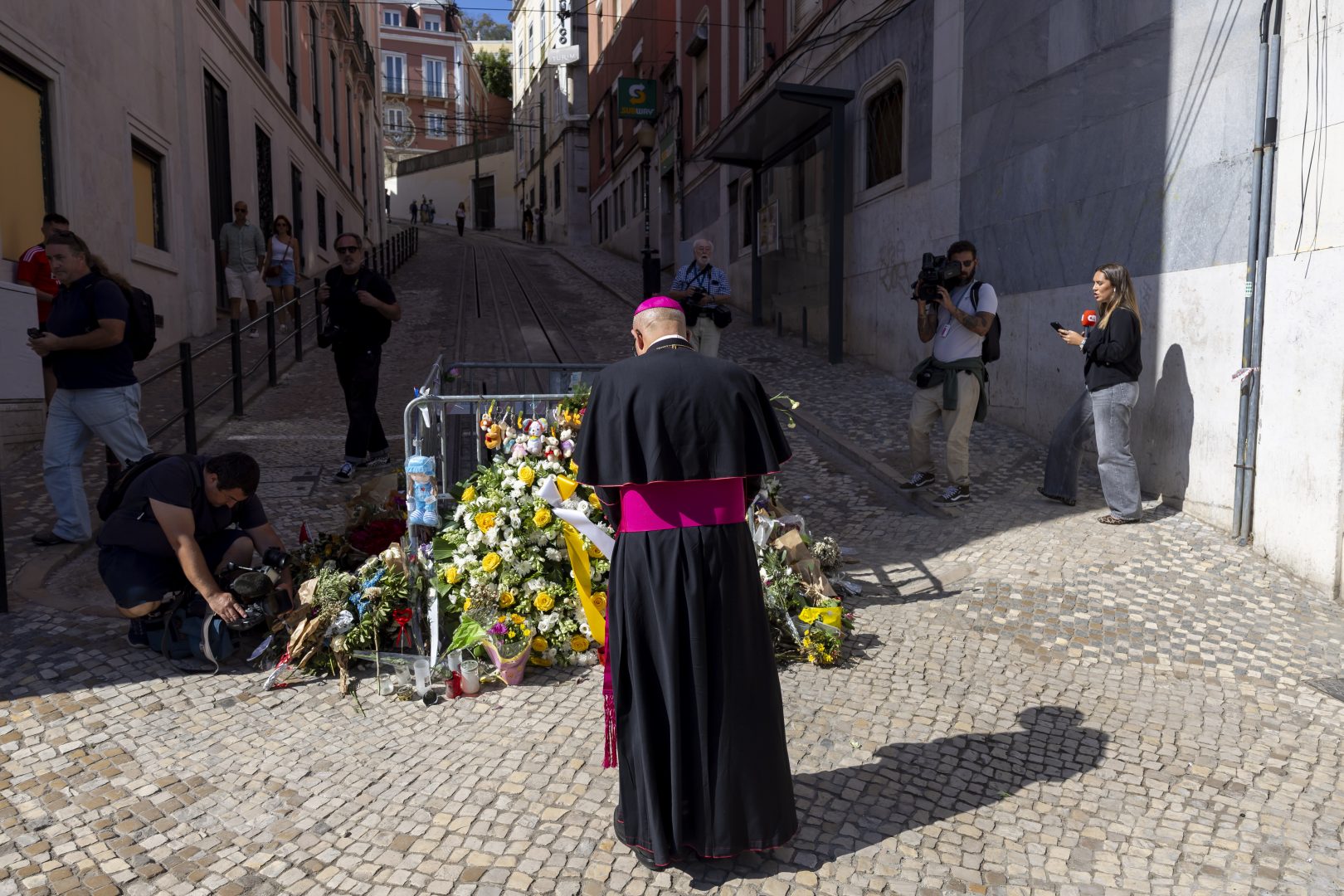
Image: epa12373053 Portuguese Bishop Rui Manuel Sousa Valerio prays for the victims of the funicular crash at the site where the accident occurred, in Lisbon, Portugal, 13 September 2025. On 03 September, one of the streetcars on the Elevador da Glória funicular derailed and collided with a structure. At least 20 persons were injured and 16 people were killed. EPA/JOSE SENA GOULAO
Copyright: © 2025 LUSA – Agência de Notícias de Portugal, S.A.