


Portugal’s centre-right AD coalition government “declares war” on corruption and red tape
It’s finally happening! After 50 years – or probably even before if Portuguese early 19th century author and social critic Eça de Queiroz is anyone to go by -, a Portuguese government is tackling something that has plagued southern Mediterranean countries for decades; Portugal being no exception – red tape and corruption.
Text: Chris Graeme; Photos: Fernando Bento (ICPT)
Portugal is “declaring war” on bureaucracy and corruption. But how do you essentially declare war on yourself in a problem so endemic and deeply rooted? A tall order, but one the Minister of State Reform, Gonçalo Matias is determined to do.
Red tape has long been identified as a major cause of corruption, hence deregulation was advocated as an effective anticorruption tool, an advice which many country followed.
However, there is a lack of robust systematic evidence on whether deregulation and less red tape actually lowers corruption.
This is partially due to the difficulty of defining what is good regulation, but also to the lack of theoretical clarity about which type of corruption regulations impact on, and to the deficient measurement of different types of corruption.
Gonçalo Matias believes that corruption in Portugal’s public administration arises precisely because procedures and processes are so slow, opaque and there’s no predictability over a decision, and that leads to corruption.
“If we had clear procedures, that were executed swiftly and were predictable, then there would be no incentive for corruption.”
Another problem is a lack of interoperability, meaning “we have silos in various State departments and ministries, and sometimes silos within silos within the same ministry and it’s difficult to break these silos”, said the minister.
This was why, despite digitalisation, things didn’t work, and it needed the political courage and agency to have the power to tear down these silos which had taken decades to build with a lot of kick-back against their destruction.
The minister’s number one goal is, within four years, to enhance, re-organise, and transform the way the Portuguese State is run; cutting red tape, banishing the duplication of the same or similar tasks across different ministries or government agencies, and streamline the entire government operation right across the board in all ministries and their departments – in other words a complete shakeup of Portugal’s civil and administrative services.
But in a world of political party clientism, cronyism and ‘jobs for the boys’, it’s not going to be an easy feat to double down on decades of installed lobbies – a vast gravy train of favours and ‘cunhas’ that slows Portugal down and bleeds the very life blood out of State efficiency, effectiveness, economy, innovation and progress, like a vampire.
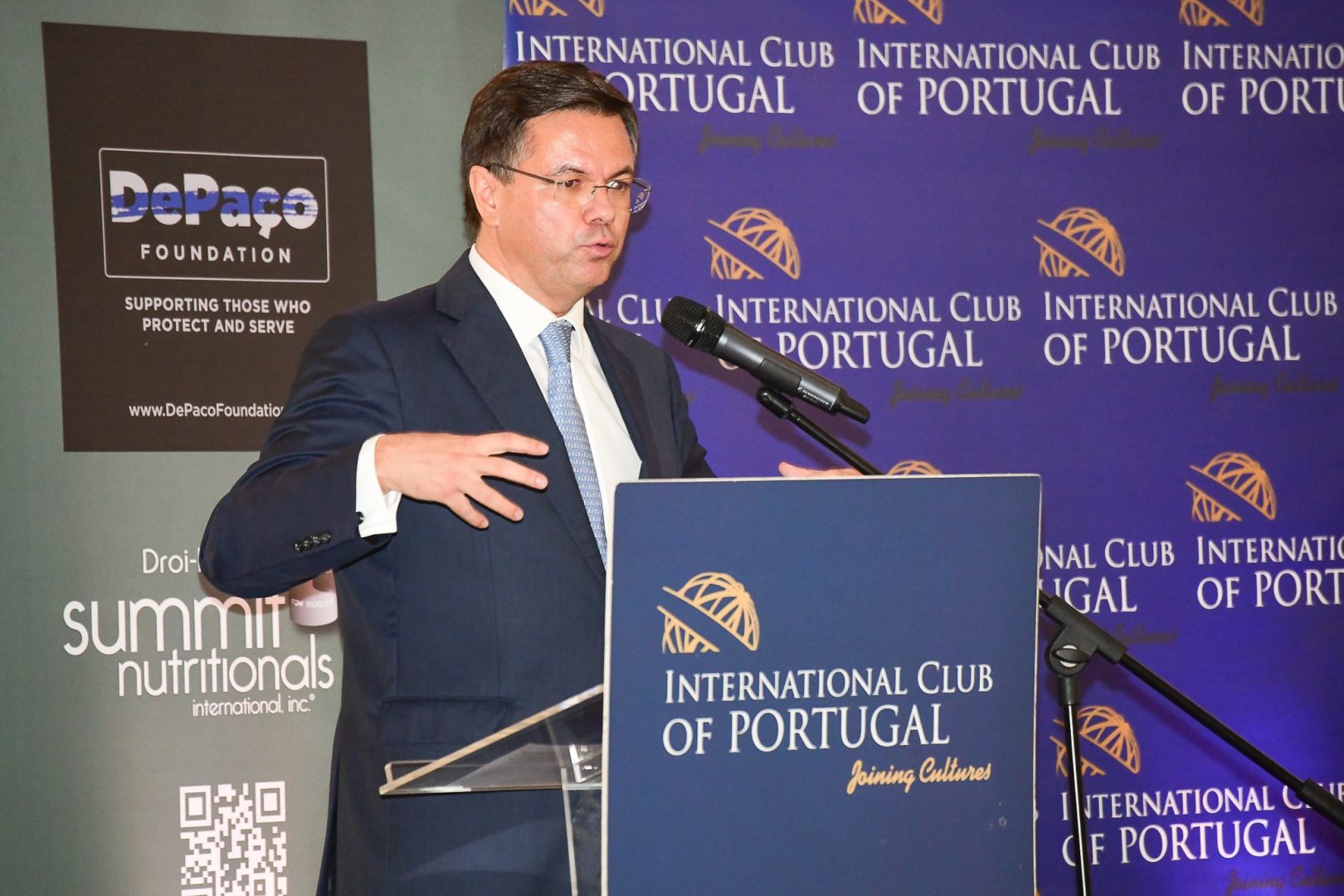
Speaking to movers and shakers at the International Club of Portugal at the Lisboa Sheraton Spa hotel on Monday, October 20, Gonçalo Matias pronounced:
“There is one fundamental diagnosis when it comes to the state that we have to tackle and it has to do with the costs of bureaucracy”, he said and in the context of State reform “we’ve declared war on red tape”.
Don’t stop the train!
The minister also said it might be great to “destroy the State and rebuild it from scratch” but “we haven’t time and can’t stop the train”.
“We’re carrying out a reform of the State from within, so the goal isn’t to destroy the State and start again from scratch. Unfortunately or fortunately that’s not possible. We haven’t got time to do it to build a new one; we have to reform the state from within as it is, and while the train is moving so that we can attract investment and retain talent. It’s a national plan”, assured Gonçalo Matias.
The Minister also plans to change the law regarding the Tribunal de Contas – the government’s audit office – and the way it operates which he says “stifles decisions” adding that such an institution should function to “check the legality of acts and actions taken”.
Portugal’s Court of Auditors oversees the legality and proper management of public money, checking public accounts, revenues and expenditures. Its mission includes assessing the legality of operations, the regularity of revenues and expenses, the efficiency and effectiveness in the management of public funds, and it can carry out financial responsibilities in the event of infractions.
“I believe that an audit office is not supposed to replace a political or administrative decision-maker and should only operate within its jurisdictional remits”, he said, adding that he aims to reduce its prior approval and increase its approval posteriori or post approval without reducing any supervision.
The minister aims to avoid a scenario whereby there could be a violation in the separation of powers, so that there should be no confusion between the function of judging and administrating.
Making business setup faster
In Portugal, if you look at the numbers, it takes on average 356 hours to set up a company and another 391 hours per year in legal and administrative obligations.
“Compare this to Poland where it takes an industrial company there an average of 19 hours to set up, while in Slovakia obligations of the same nature never exceed 272 hours per annum.
In other words, when a Portuguese entrepreneur starts his business activities, he starts on the back foot immediately with his time eaten up with … well, red tape, losing an entire quarter of a business year in the process.
The minister admitted that if the truth were told, Portugal has managed to accumulate five layers of bureaucracy across various sectors of society, and the government realised that it had to face up to reality; and do so with courage and purpose with a top-down reform of the State.
Simplification and digitalisation
The Portuguese government’s State reforms are based on two main pillars: simplification and digitalisation.
“Portugal can no longer be a country of paper, rubber stamps and queues. We have to be a country of confidence and trust, (where processes) are predictable and fast” said Gonçalo Matias.
He said that Portugal’s public administration had been built over decades in a spirit of mistrust. This meant people mistrusted one another, and mistrusted the State while the State mistrusted both its businesses and citizens.
“How could we compete with our partners (in Europe) if we couldn’t even manage to create an environment of trust?”
This was the first “contract” from the government: a contract between it and its citizens and businesses to make things easier, simpler, and faster through technology and efficiencies.
It was this lack of trust and faith in the honesty of its citizens and businesses that had led to an endless paper trail of documents, creating endless procedures that could take years.
“This is, to a large extent, a consequence of a lack of trust”, said the minister who added that in a State of Law, in a civilised state, a State should let its citizens act, and pursue their personal and business projects, but then be there to supervise and punish when the law was broken.
“Instead, we’ve been doing things the wrong way round. We admit the justice system doesn’t work, so why talk about responsibility if justice doesn’t work. And since no one is responsible, it is better to act beforehand, and not allow people to act and do something, build something and have projects”, he said with irony.
The need for predictability and celerity
The second dimension had to do with predictability.and it was vital to ensure it. “Today, when an entrepreneur comes to us, we can’t tell them how long it will take to get authorisation or planning permission, to get a licence to build a factory in Portugal.
“And we can’t tell them how long it will take for that factory, what will be the impact on the capital (from investors) and how long that capital will be on ice waiting for licences.”
Gonçalo Matias admitted that in one sense investors were “heroes” because nevertheless, they had decided to invest in Portugal when many others had decided to invest elsewhere in countries that offered better conditions for investment and processes that were faster and more predictable.
The third idea was swiftness. “We can’t have a system where it takes months or years to decide. So speedy decisions are vital so we’ve decided to put companies and citizens in the centre of State action.
“We essentially have had to create the conditions for a profound reform of the State. The minister believes, after so many failed or inadequate attempts to reform the State in the past, that this time will be different, this time it will work.
Let’s hope this time he’s right and he doesn’t face a wall of resistance from interested parties that is so insurmountable that even his Ministry of State Reform can’t scale it.
Chris Graeme