


Risk as an opportunity for Portuguese companies
LEADERSHIP SUMMIT 2025
Data for business in 2024 shows that there was a fall in the number of new companies setting up in Portugal and an increase in the number of insolvencies.
It is undeniable that recent year have been marked by a reduction in company and entrepreneurial dynamism, a reflection of the impact of a series of crises (the Covid-19 pandemic, inflation, and geopolitical instability), but also a perception of growing risk as a factor for paralysis rather than action.
That said, economic history, and the way more resilient organizations behave, show that risk can also be a driver of growth.
How can entrepreneurs and business leaders distinguish between avoidable risk and strategic risk? And how can they develop a business culture capable of spotting opportunities where others see only risk?
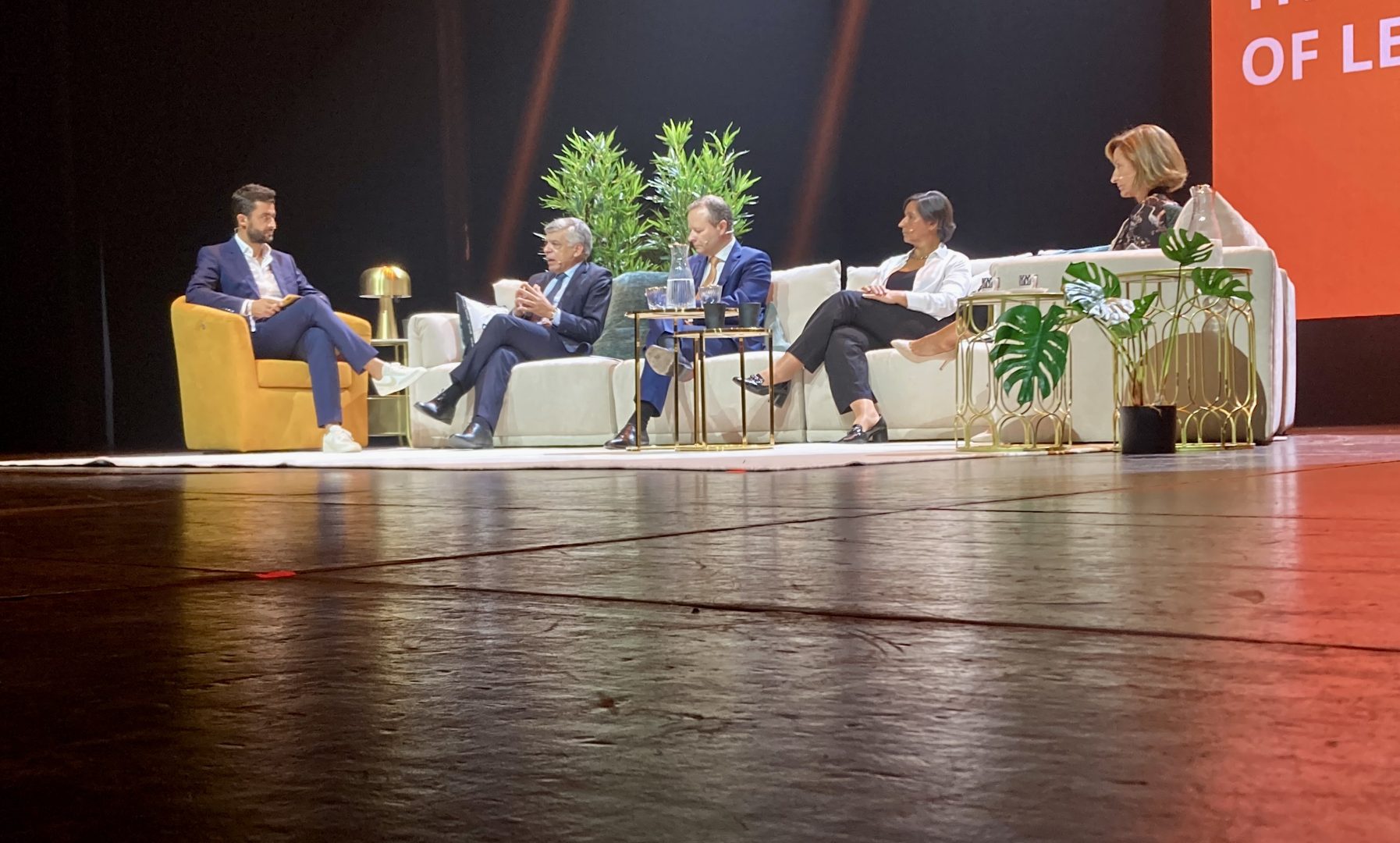
These were some of the conundrums discussed on the panel ‘Risk as an opportunity for Portuguese companies’ at Thursday’s Leadership Summit Portugal 2025 held at the Casino of Estoril in the popular upmarket Lisbon riviera resort, Estoril.
The debate involved the top-drawer Portuguese business leaders Armindo Monteiro, President of the Business Confederation of Portugal (CIP), Alberto Ramos, Country Manager of bank Bankinter Portugal, Sandra Silva, CEO of water, waste and energy management company Veolia, and Alexandra Reis, Senior Counsel PT for Philip Morris tobacco company Tabaqueira, moderated by Pedro Brito, the Associate Dean for Executive Education and Business Transformation at business school Nova SBE.
Pedro Brito (Novo SBE) asked if high interest rates and more cautious lending were limiting new investments for companies?
And also asked if the ESG regulations, and energy transition compliance measures that increased costs and complexity, particularly those of processes, were undermining those companies that had to implement them?
And if these excluding global multinationals from the European and Portuguese market or from green financing?
Equally, he asked about investments in cyber-risk and fraud at a time when more than 17% of Portuguese SMEs have already suffered from some form of cyberattack, with 12% of these companies suffering a direct financial impact as a result.
Armindo Monteiro said that entrepreneurs did not have an aversion to risk and that it was actually in the nature of an entrepreneur to take risks.
“What business owners generally don’t like is unpredictability” he sad. This unpredictability came from “outside the company” and that “naturally today we live (at a time) when the perception of risks comes from outside the business.”
However, he pointed out that there had always been risks throughout history, but that today, with the various forms of communication, “I think the threat of risk is greater”.
“We know that wars (trade or military) go in cycles as do pandemics and catastrophes, but the difference is that it has never been quite like today”, he said.
“All of us in Portugal have this spirit of entrepreneurship but we lack resources. The idea of being spirited and having the desire is important, but it’s not enough.
“We need an ecosystem, and this requires ideas, knowledge, teams, ways of financing, and to be aware of contextual costs,” he sad.
“At the end of the day taxes and supervision, rigid or flexible hiring arrangements – a whole number of resources”.
Armindo Monteiro added that Portugal ’s business models were becoming more sophisticated and that it was “climbing upon the value chain”.
“Today, Portugal is now producing unicorns but I have to day, and we all know it, that most of our companies are micro or nano-companies”.
The CIP leader said that 80% of Portugal’s companies were micro-companies, and naturally “we need to create more value added, better leadership, and a lot more productivity”.
Sandra Silva, the CEO off Veolia, which created the first water recycling unit in Portugal, pointed out that there were new challenges such as moving away from or reducing dependence on fossil fuels from a specific geography towards electrification where “we depend on other raw materials in other places, which we also depend on”, so that Europe has “an opportunity to recycle other types of materials and therefore gain its own independence”.
Alberto Ramos, Country Manager of bank Bankinter said that taking risks was at the core of the banking business and was something banks did on a daily basis.
“We can’t grow without taking risks, and there are a number of principles when it comes to risk-management; this is something that has changed over the years. Risk has always existed, but there are more different forms of it than we had some years ago,” he admitted.
“The truth is that risks today are much more complex, universal and interdependent which requires very different approaches from institutions, be they financial sector organisations or other types of companies. In our case risk there is but the question is what is healthy risk and what is not?”
Ramos said that Bakinter knew the risks, was able to identify them, measure them, and had all the information to react accordingly.
“The role of a bank is to help companies take the best options, and at certain times take difficult decisions, but ones that are for the good of the compares involved, particularly when a project is not viable.”
“The truth is that when we look at the bank today, we see a sold bank that is profitable and efficient, and is a success story in the Portuguese market”, he explained.
Alexandra Reis, Senior Counsel PT for Philip Morris tobacco company Tabaqueira, who runs a company in a sector that is very tightly regulated, said that apart from the traditional ways in which risk was managed, they had to identify, plan and mitigate like the banks and any other company in Portugal had to do. “It is part and parcel of the culture and way companies have to look to the future”.
“The products we have are highly regulated, and there are vicissitudes ,and we have to be highly disciplined. We are a company that has to be willing to take these risks, and this has been particularly true in recent years, and as part of Philip Morris we decided that we had to reinvent ourselves and change”.
“We had to look at the future survival and sustainability of the business, and respond to the demands and needs of society, because a company that is sustainable is one that meets the expectations of that society”, she sad.
This meant that the company had to reinvent itself, and at a cost, as well as taking on great risk. “n Portugal we’ve gauged this risk successfully, we’ve embraced this challenge, and have invested some €420 million continually over the past 20 years”, the executive said.
“In Portugal we’ve shown resilience and the capacity to adapt in order to attract investment”, affirmed Alexandra Reis.
“We knew from 2016 that we had to stop making cigarettes and make something else, which was completely disruptive at the time, so much so that we thought it was the end! But we took the risk and dd so with a lot of investment behind it”, she added.
The result is that today the company produces both traditional cigarettes and, more significantly, smoke-free alternatives, including heated tobacco products, e-vapor, and oral smokeless products, all under its parent company’s vision of a smoke-free future. Located in Portugal, its factory serves as a key production centre for both the domestic market and for export to over 25 countries.
Photo: Chris Graeme: L-R: Moderator, Pedro Brito (Novo SBE), Armindo Monteiro (CIP), Alberto Ramos, Country Manager of bank Bankinter Portugal, Sandra Silva, CEO of water, waste and energy management company Veolia, and Alexandra Reis, Senior Counsel PT for Philip Morris tobacco company Tabaqueira.