


Government pledge of €2.5Bn after Storm Kristin may not be enough
The Portuguese Prime Minister Luís Montenegro announced on 1 February that the Council of Ministers adopted a package of measures to support the population and companies in recovering from the effects of storm Kristin, which hit mainland Portugal overnight from 27 to 28 January.
In addition to extending the disaster situation status until 8 February, a series of emergency and recovery measures were presented to an overall sum of 2.5 billion euros to support citizens, companies and the recovery of public and private infrastructures.
The storm, which struck central mainland Portugal between January 27-28, 2026, caused widespread devastation, with wind gusts exceeding 200 km/h, significant flooding, and at least 5 to 6 deaths – a toll that has since risen to 15 following subsequent storms.
In terms of business support (€1.5Bn), the state-owned development bank Banco de Fomento is rolling out a €1Bn loan programme for rebuilding uninsured factories, and a €500 million credit line for short-term cash flow needs.
As to financial and tax relief, the government has applied a 90-day moratorium on loan repayments and mortgages as well as a six-month exemption from social security contributions for affected companies.
The government has also requested additional funds from the European Union to help with the recovery.
However, the costs of Storm Kristin is likely to exceed €4Bn and Portugal’s Minister for the Economy and Territorial Cohesion, Manuel Castro Almeida admitted last week that the estimated costs were “preliminary”.
This estimate, he adds, does not even take indirect costs into account. For example: “A company in Leiria that manufactures parts that enter the production chain of another company in Braganza or Évora, which has nothing to do with the storm zone, but will affect the production capacity of the other factory” he said.
“From an economic point of view, it will be a very significant blow”, he anticipates, acknowledging that the impact on exports is “inevitable”, although he highlighted the willingness of business owners to overcome the damage left by the storms and would meet orders to avoid the risk of being replaced by other suppliers.
According to tourism sources, tourism businesses in central Portugal are facing a €9 million storm damage bill.
The Portugal Tourism Board for the Centre Region said the losses were “squeezing the cash flows of hotels, restaurants, and tour operators just weeks before the Easter bookings rush.
The Banco de Fomento has also launched a €1Bn credit line which is outside government funds.
The credit line has been made available to companies to help invest and mitigate the impact of the downturn but is not covered by the de ‘minimis’ scheme.
“Companies are very worried about the possibility of reaching the state aid cap that would prevent them from applying for more support in the form of traditional European funds, or treasury lines in the context of the calamity.
This moreover, is one of the topics that is being discussed today during a clarification session in Leiria and Figueira da Foz”, said Henrique Carvalho, executive director of Nerlei, the Business Association for the Leiria Region, in an interview with the online news source ECO.
SOURCES: ECO & The Portugal Post
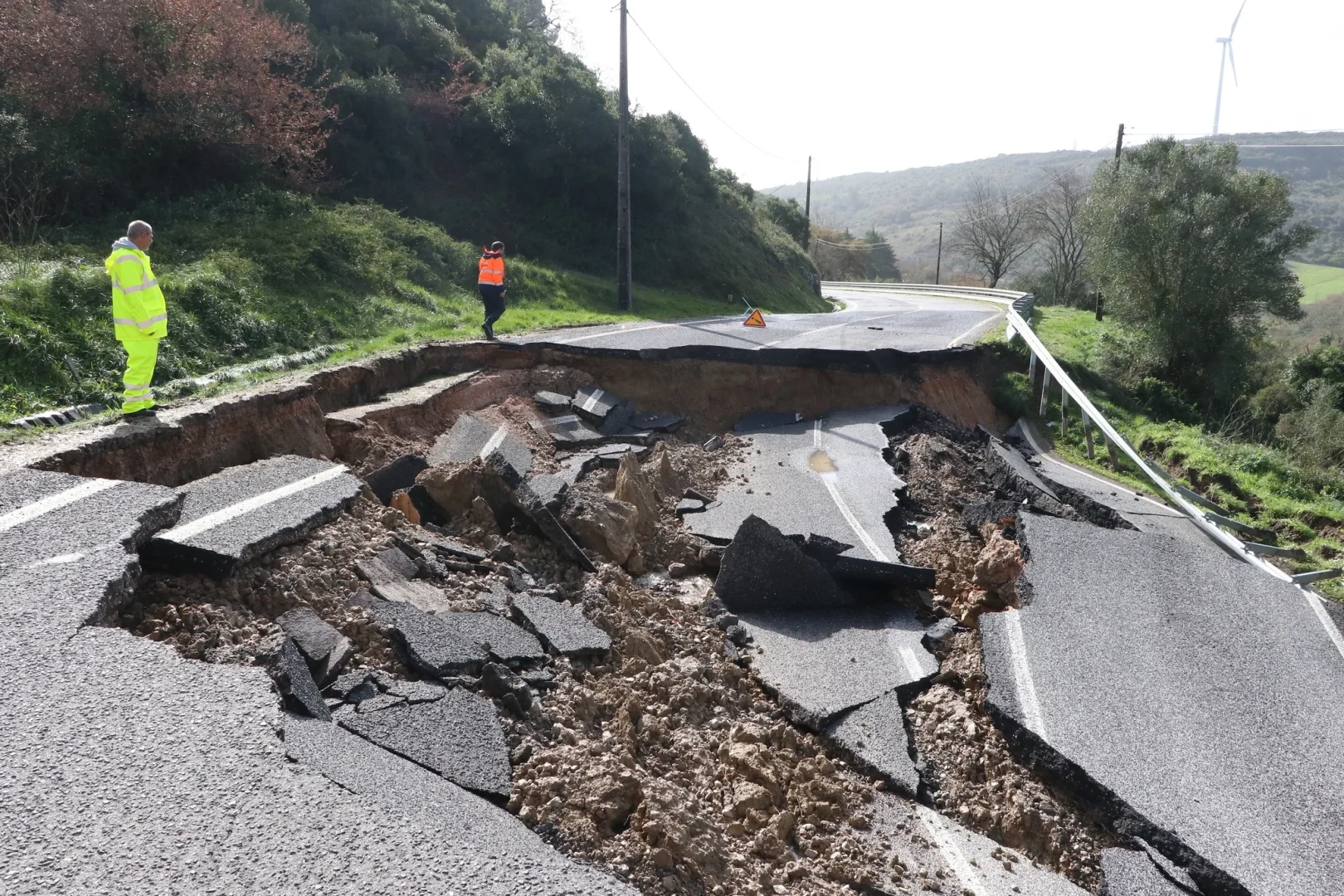
Image: Storm damage has collapsed roads in many parts of Portugal. Photo: CM Arruda dos Vinhos.