


PRESIDENTIAL ELECTIONS 2026 – Portugal’s voters create ‘cordon sanitaire’ against far right in presidentials
Portugal’s PS Socialist Party candidate António José Seguro won the presidential runoff elections held on Sunday with more than 65% of the vote (1,729,371 votes) against far-right populist candidate André Ventura whose Chega party garnered 34%.
According to the oficial results with 99% of the votes counted it means that Seguro netted a record number of votes ever held in a democratic presidential election in Portugal, exceeding those of the founder of the PS party and father of Portuguese democracy, Mário Soares, in the elections of 1991.
Seguro becomes the first president from the socialist party in 20 years and now returns to the forefront of national politics. In his victory speech, he promised to be a “demanding and vigilant president, but never a counter-power”.
“I promised loyalty and institutional cooperation with the government, and I will keep my word. I will never be a counter-power, but I will be a president who is demanding when it comes to solutions and results,” said Seguro.
“The Portuguese people are the best in the world” António Seguro told reporters as he left his home in Caldas da Rainha on Sunday, adding that voters had shown “enormous civic responsibility and attachment to the values of democracy”.
Considered somewhat predictable and uncharismatic – Seguro’s original victory speech was said to be “long and boring”. An expert on the Portuguese constitution, he is nevertheless seen as a safe and reliable pair of hands to offset the radical right rhetoric of Chega’s André Ventura.
Going head-to-head in a runoff campaign largely overshadowed by the worst storms and flooding to hit Portugal since records began, it was a victory of moderation over extremism, and a return to the traditional two-party politics voting that has characterised the Portuguese political landscape over the past 40 years.
Ventura: “Soon we’ll govern this country”
Nevertheless, André Ventura exceeded the votes Chega achieved in the general election held in 2025, effectively reinforcing the reality that at least 20% of Portugal’s electorate feel disenchanted with the current political establishment on issues such as political party corruption, cronyism, immigration, the rising cost of living, and the erosion of traditional family values.
Tough on crime and criticising the payment of subsidies and free healthcare for Portugal’s 60.000-strong gipsy community, during the campaign Ventura put up billboards across the country saying, “This isn’t Bangladesh” and “Immigrants shouldn’t be allowed to live on welfare.” He promised strong state support for those on low incomes, but only for Portuguese nationals.
His brash, straight-talking yet charismatic image took a dent during the campaign when he suggested Portugal needed “three Salazars” to put the country in order. It was an unfortunate and indelicate statement that would have gone down like a lead balloon with over-60s socialist and communist voters whose collective memory recalled the António Salazar dictatorship in the last century in which thousands were imprisoned and tortured for opposing the Christian-nationalist, non-democratic regime.
His party Chega, founded in 2019, succeeded in netting its greatest number of votes in the snap elections on May 18, 2025 with 1,437,881 votes, corresponding to 22.75% of the total, and placing 60 MPs in the Portuguese Parliament, making it the second largest party in parliament.
In this general election, the Democratic Alliance AD (PSD/CDS-PP parties) was the most voted, with 1,971,602 votes, 31.20% of the total, and elected 88 MPs, to which were added 36,886 votes obtained by the PSD/CDS-PP/PPM coalition in the Azores, with three more elected parliamentarians.
In the first round of these presidential elections held three weeks ago on January 18, André Ventura was the second most voted, with 1,327,021 votes, 23.52% of the votes cast.
André Ventura had also been a candidate in the presidential elections of January 24, 2021, in which he came third with 497,746 votes (11.93% of the votes cast), behind independent Ana Gomes and the re-elected President, Marcelo Rebelo de Sousa.
Media pundits suggest that despite his defeat in these presidential elections, André Ventura could become Prime Minister of Portugal in the next general elections predicted for October, 2029.
Despite the defeat, André Ventura was magnanimous to his opponent, saying: “The success of António José Seguro will be the success of all”.
“This party had its best result ever” he added, and reminded that Chega had exceeded the result that the ruling Democratic Alliance had won in the last general election in 2025.
“We lead the right in Portugal and soon we’ll govern this country”, Ventura affirmed. We didn’t win, but we’re on the road to victory”, he promised.
The final result of Sunday’s runoff did not figure the centre-right governing coalition Democratic Alliance (AD) party comprising the coalition Social Democratic Party (PSD) and more conservative Christian Democratic Populist Party (CDS-PP) since its candidate lawyer and TV commentator, Luís Marques Mandes had been eliminated in in the first round on January 18.
In a world driven by image and personality, Marques Mendes simply didn’t have the stature or personality to represent Portugal on the national and international stage while the AD failed to come up with a convincing, charismatic, and commanding alternative.
A vote against government performance or a vote against populism?
There was a certain irony to this Socialist win on Sunday since Portugal’s economy is doing better than most of its European peers, with the current government led by Luís Montenegro being a model of public spending and financial housekeeping responsibility while growth was above the EU average at between 1.9% and 2.0% last year, leading the UK magazine ‘Economist’ to vote Portugal the ‘Economy of the Year’.
Predictably, André Ventura, a lawyer, former PSD parliamentary deputy and popular TV football pundit, said he had effectively been ganged up against by the two mainstream parties, but at the end of the day it was a victory of the traditional political system, for democracy, and stability.
In some ways this was true. Seguro, 63, had been backed by politicians on both sides of the Portuguese parliament, with several conservative figures voicing public support for the moderate socialist to ensure that the far-right candidate who wants to change the constitution to deliver greater powers to the presidency, didn’t get his foot in the door.
From the corridors of power in the European Union, President Ursula von der Leyen congratulated Seguro on social media posting: “Portugal’s voice for our shared European values remains strong.”
French President Emmanuel Macron also congratulated Seguro, saying he would work with the new president to strengthen ties between Portugal and France.
António José Seguro – where did he come from?
It was during the PS Socialist government of António Guterres that Seguro’s political ambitions began to rise rise, serving as Chief of Staff to the Secretary-General of the PS and was directly elected as a parliamentary MP (representing Lisbon and Leira at different times,) in the 1991 legislative elections.
From 1994, Seguro was part of the Permanent Committee of the National Secretariat – the hard core of “Guterrismo”.
With the victory of the Socialist Party in the October 1995 legislative elections, Seguro assumed the role of Secretary of State for Youth, a position he would leave to run for the 1999 European elections, second on the Socialist list, behind the head of the list, Mário Soares.
Seguro returned from Brussels after a two-year stint serving as a Euro MP to join the Guterres government as Adjunct to the Prime Minister replacing Armando Vara.
In 2004, he was in the process of competing for the leadership of the party with José Sócrates, but, according to reports from socialists of various factions, Jorge Coelho, the then strongman of the apparatus, asked him to wait.
During Sócrates’ government, Seguro was always in second line, despite having been the head of the list for Braga in the 2005, 2009 and 2011 legislative elections and chairman of the parliamentary committees on Education and Economy, in addition to having coordinated a reform of Parliament in 2007.
In 2011 he made a bid for the leadership of the PS Socialist Party and won against opponent Francisco Assis. He remained head of the party until September 2014 when António Costa took over the leadership until 2023 both as leader and prime minister.
Text: Chris Graeme
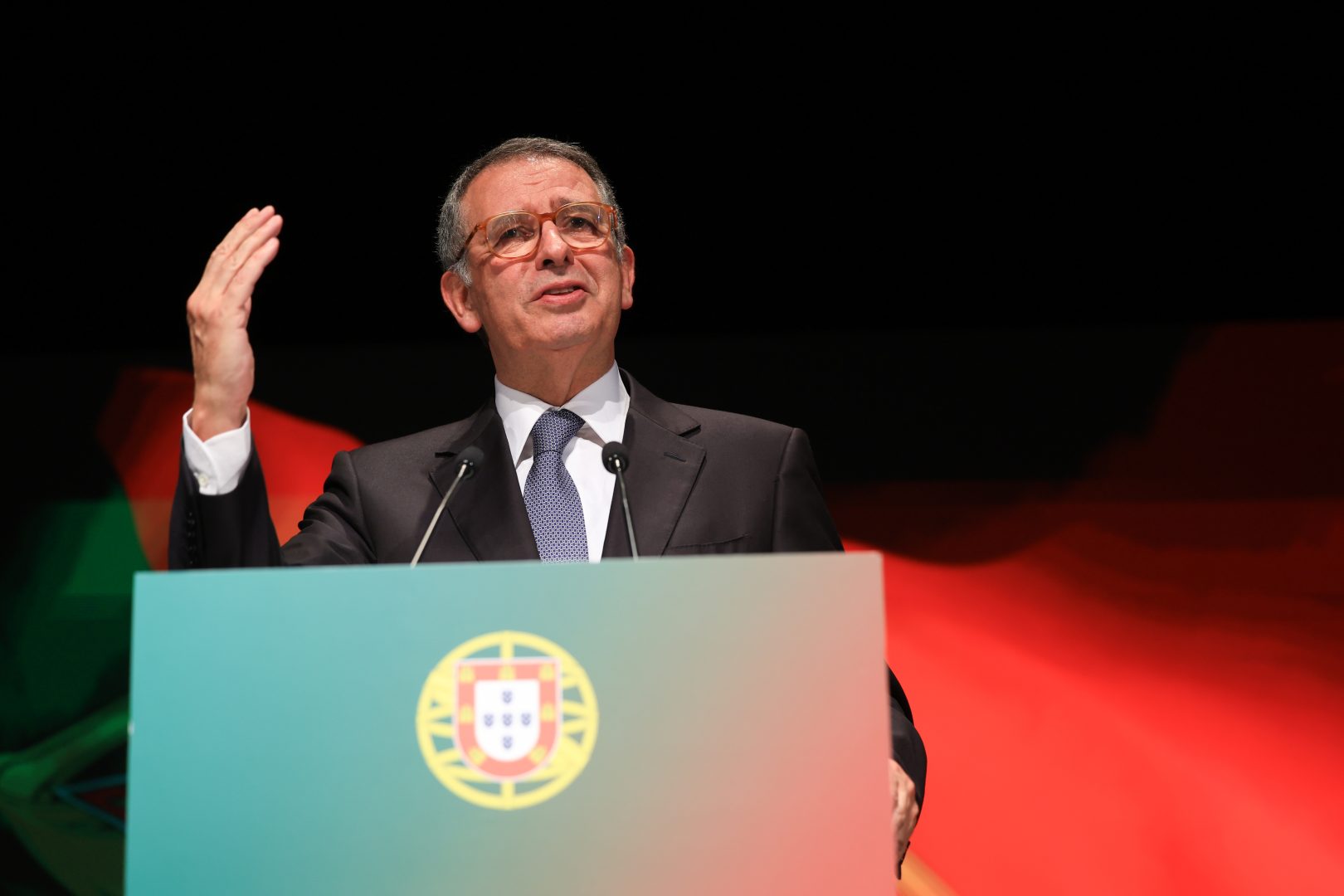
Image: epa12718653 Presidential candidate, Antonio Jose Seguro, delivers a speech after his victory in the second round of the Portuguese presidential election in Caldas da Rainha, Portugal, 08 February 2026. More than 11 million voters were called to choose the new president in a runoff between Seguro and Andre Ventura, the two candidates who received the most votes on 18 January. EPA/JOSE COELHO
Copyright: © 2026 LUSA – Agência de Notícias de Portugal, S.A.