


The Portuguese real estate market in 2026 – what’s changing?

No Filters Conference – “Crisis no, but transaction numbers will adjust”
Text and Photos: Chris Graeme
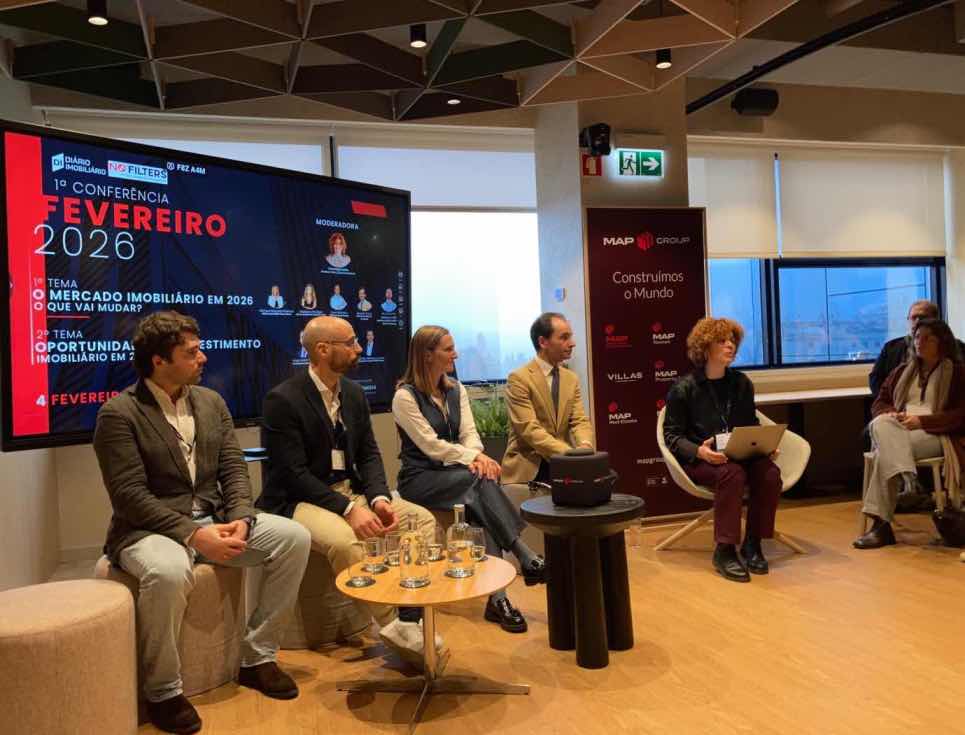
A snapshot of expectations for Portugal’s residential real estate market for 2026 was provided by a panel of experts in Lisbon on Wednesday at the ‘No Filters Conference – the Portuguese real estate market in 2026 – what’s changing?
Organised by Diário Imobiliário, the overall sentiment was that continuing high demand would mean that there would not be a major slowdown in Portugal’s real estate market as families sought to trade up to larger properties taking advantage of property valuations over the past decade.
Market “not so euphoric”
Fernanda Pedro, Managing Director of Diário Imobiliário kicked off the conference held at the offices of the MAP Group – a large construction, development and real estate group – by suggesting that Portugal’s real estate market was not so buoyant this year as last, with developers, investors and estate agents more reserved and cautious for 2026 as buyers become more demanding and selective over what they are looking for, showing “some caution” before buying.
Nevertheless, Fernanda Pedro moderating the discussions, emphasised that the Portuguese real estate market continues to be appetising for both national and overseas investors, both in commercial and residential segments.
The CEO of Century 21 Portugal, Ricardo Sousa, reminded that 2025 had been a good year for residential sales with a healthy volume of transactions that has been “above what we had originally expected”.
However, the last quarter of the year had shown the market slipping somewhat, although demand continued to be quite buoyant.
“We’ve had constant demand from people wanting to buy their first home, or move house and trade up with the capital that they had amassed from their properties gaining value and using it to buy a new, potentially larger property.
“We have a record percentage of the population working in Portugal, and the attractiveness of our country has risen, so demand is high although the supply is not keeping pace,” he said.
This supply scarcity was particularly glaring for new build, essentially in the lower middle class and middle class segments where there was the most demand.
And it was this lack of supply that had kept prices high while the market was focused on people moving house.
An example. A person who bought a two-bedroom house in Odivelas 10 years ago would have seen the value of their property soar, so with a part of the mortgage they had already paid off and the increased value of their home over a decade, it was easier to sell and trade up to a three-bedroom apartment.
“This means that despite the lack of supply the market has been able to continue working.
On the other hand, government incentives for young people to get their foot on the housing ladder has meant these have been able to buy those two-bedroom houses vacated by those trading up.
“These incentives have obviously been a huge driver for first-time buyers. But the international buyers market has shown signs of waning so far in 2026, incredible as it sounds”, he admitted.
“Our clients have their mortgages approved, they have the cash, but they can’t find the house they want in their price range.
In other cases, house hunters can meet payments at the end of the month, but salaries have grown at a much lower level than house prices on those properties that are still available, but now are beyond their reach”, added Ricardo Sousa.
A third factor was that the Portuguese, he said, were very conservative buyers, don’t like moving outside of their own cities, neighborhoods, and want to be close to their families and friends which only complicates the situation in the national market.
Another problem was that demand in Lisbon, Oeiras and Cascais had pushed prices up so much that these were now unaccessible to most families.
“No one can buy houses in these boroughs unless they already have property, thereby forcing people to leave Lisbon and look elsewhere.”
Director of Real Estate at Doutor Finanças, Bruno Coelho, agreed that the salaries of Portuguese families were “not keeping pace with the high prices of houses” which he believed would continue to be high.
“Despite there being access to mortgages, we’re seeing a slowdown in the number of transactions so far in 2026”, he said.
Crisis? What crisis?
The data has shown that there has been a fall in sales so far this year when compared to the last quarter of 2025, with this being a portent that 1Q of 2026 will show a slowdown in the national market in these key metropolitan areas for middle class buyers.
Did this mean a crisis was on the horizon? No. “We believe things will stay more or less the same, but sales will stop climbing as they have been, and there will be an adjustment in the market, but it will be another good year”, concluded Ricardo Sousa, CEO of Century 21.
In other words, the market would be a little more challenging in 2026 with perhaps some market correction in the number of transactions rather than in prices, but the question remains by how much?
Is Simplex working?
Two years ago, the Portuguese government approved its Simplex programme for licensing properties, specifically the “Simplex Urbanístico” (Decree-Law 10/2024) effective from March 2024.
This is a major legislative reform designed to slash bureaucracy in real estate. It eliminates the need for habitation licenses in property sales, reduces required administrative approvals, and replaces some licenses with simple prior notifications to speed up development.
For a decade, the various players in the real estate sector had called for changes to the complex, cumbersome and slow real estate licensing processes.
They wanted less bureaucracy and faster decisions in a bid to encourage developers to provide more housing on the market.
In 2025, the new Simplex for Urban Licensing came on line and had various positive aspects that cheered the real estate sector in Portugal.
But in some instances it seemed it had gone far. Most of the 26 measures of the new Simplex came into force on March 4, 2025, but some were already being practiced since the start of 2024.
One of the most controversial is related to the purchase and sale of houses, no longer being mandatory to present, by default, the license of use at the time of acquisition.
The President of the Portuguese Real Estate Developers and Investors Association APPII, Hugo Santos Ferreira, said that despite some stakeholders having reservations, the measure was broadly welcomed by the sector
“Continuing as we were was not the solution and it was really unacceptable to do nothing, so I see this Simplex as an important and necessary first step in the fight against one of the biggest cancers in our economy and I would even say in our democracy – bureaucracy,” he said.
He said the elimination of building permits and the preferential use of the prior notification mechanism should not cause difficulties for real estate developers with investors, banks, and insurance companies, but were.
In a situation where the only required documents are proof of payment of fees or even prior notifications, it remained to be seen how those entities will deal with this guarantee which – although it provides positive speed in the construction process – requires, to achieve it, the weakening of guarantees and legal security for market players.
Some projects at affordable prices achieved
Mariana Morgado Pedroso, CEO of Architect Your Home, on the construction side, said that several developers her company was working with had been managing to build good apartment projects at good prices.
“It’s a myth that the only developments that get built are expensive. It is possible to deliver quality at a fair price.”
“Instead, the problem, despite Simplex, continues to be getting projects licensed in a reasonable time but I think we continue as a sector to be somewhat obsessed with the price of houses”, she added.
The end of cowboy builders?
Bruno and Ricardo Sousa agreed that 2026 would be a year of professionalisation in which those builders who were most professional would gain market share while cowboy builders or “brave ducks” as they are referred to in Portugal, would lose market share and could even eventually disappear.
“All these State benefits (VAT at 6% for builders and tax breaks for young people) obviously will benefit from a social crisis point of view and make sense, but this is not going to increase the attract more developers to build in Portugal”, said Sousa.
But André Casaca (La Place) lamented that the government’s reduction of VAT on construction from 23% to 6%, aimed at upping housing supply would not, in his opinion, “bring down prices” in the lower-middle class and middle class segments of the market.
Casaca also warned that the public guarantee given to young people and the reduction in IMT property tax (IMT) for first time home buyers could cause price speculation in the market.
On the upmarket supply side, Mariana Morgado Pedroso said that the renovation of prime heritage real estate had “mostly been exhausted” leaving rehabilitation to “less interesting buildings”.
“The problem is licensing and tax. We have to become more attractive for builders in order to get product on the market. Product is measured in years unlike demand which is in months”. This was going to take time and political courage to solve the problem.
But what about the extraordinary measures for housing announced by the European Union in December last year to allocate money for the market?
A lack of labour
On December 16, 2025, the European Commission announced the European Affordable Housing Plan, a comprehensive strategy to combat the housing crisis by boosting supply, mobilising €43Bn in investments, and reforming regulations.
Key measures include relaxing state-aid rules for social housing, streamlining permitting, curbing short-term rental speculation, and enhancing construction productivity.
The panel agreed that this EC plan to provide money for public housing and housing for affordable rents was a “no brainer” at a time when Portugal’s productive capacity was exhausted.
The problem, however, was a lack of labour making it difficult for developers to react. If on the one hand licencing was speeding up and starting to work better, would developers have the labour to be able to build?
Of course, there were new models of building such as in modules, using new technologies, or smaller floor areas, but in the short term it seemed unlikely that developers would be able to react quickly because of a lack of labour. Nevertheless, construction always needed to be seen from a long-term perspective.
On the one hand, those developers that can built properties for a €300,000 ticket for the middle classes were “easy and almost sell themselves” and there are now several developers who are producing good product at reasonable prices.
This wold be particularly true for homes up to 85m2 that people could actually afford to buy.
The difficulty was that most developers were more interested in premium and luxury segments which enjoy greater differentiation, selling lifestyles, experiences and amenities.
And here the buyers market is a lot more demanding, buyers know about legislation, prices and what’s done in other markets.
These buyers are not prepared to pay over €1 million for a house built using anything but superior materials and containing amenities as is seen with branded residences. Another niche market is focusing on security and smart living.
The problem of transport infrastructure accessibility
Another issue covered at the conference was building projects that thought about road and transport accesses.
“We don’t just think about the project, we have to think about the city, the facilities, and this is always the last thing that comes up in projects because we never think about the city as a whole”, said moderator Fernanda Pedro.
Ricardo Sousa stressed “We have to think about what we’re doing. Second, we have to think about who are we doing this for.
“We have to look at the markets and who we are building for, and how we are going to build. If we continue building in the old ways, it’s very expensive and not flexible. Today, we have intelligent, creative and flexible construction methods that also offer quality, image, good taste, design and at reasonably low prices”.
Lisbon, unlike Madrid, was restricted in terms of expansion. Madrid is built on a massive plain which allowed for mega housing projects. Expanding to the North of Lisbon entailed various problems. The city was divided by a river. There are various types of transport systems – public transport, heavy infrastructure, trains, metro, ferries. Lisbon was designed for a reality that no longer exists and anticipating current transport issues should have been thought of decades ago.
The issue in Lisbon, for example, is that a complete rethink has to be done in terms of urban planning and heavy infrastructure while the logic of looking at urban planning from the point of view of each municipality in large conurbations had to end because “this is strangling us”.
“We have to review urban planning on a municipal scale and revise the construction codes so that all the new technology that exists for construction can be included.”
Overseas real estate buyers – a changing profile
In the second half of the debate, which looked at opportunities in the real estate market for 2026, the President of the Portuguese Real Estate Developers and Investors Association (APPII) and CEO of Corcoran Portugal, Hugo Santos Ferreira, said that the government would probably “waiver” on some tax matters introduced to increase housing supply and which are currently being debated in the Portuguese parliament.
Hugo Santos Ferreira called on the sector to unite so that a golden opportunity to solve the problems facing the real estate sector were not lost.
He also talked about the importance of American investment with the Americans (and Canadians to a lesser extent) becoming major investors in real estate in Portugal.
“These really are different clients with different demands, and who ask for a type of property – different from the ones we’ve been building for quite some time.”
In the post financial crisis era, Portuguese real estate had been focusing on European and Asian clients, particularly the French, Spanish and Chinese, and the English who looked mostly to the Algarve.
Today, in the premium and luxury segments, the clients were clearly dominated by HNWI US and Brazilian clients looking for different things, such as much more generous areas in terms of square metres, services, amenities and facilities.
French interest was waning, Spanish interest was on the rise, and English interest was remaining stable. “Often we are producing products which don’t seem to take into account what the buyer actually wants and needs”, said Hugo Santos Ferreira. “Too often we’re designing architects projects as if they were pieces of art to please the architects while not stopping to take the buyers into consideration.”
Nuno Malheiro, the CEO of Focus Group – a Lisbon-based real estate project consultancy – discussed the Entrecampos project launched in early February which will have a large offer of offices, apartments and commercial spaces, but warned these would swiftly be sold, so there would continue to be a lack of apartments.
“What I feel from clients that seek our services for projects is that there is long-term demand and for larger-size projects that take more time to develop and require detailed plans that are more difficult to negotiate with municipal authorities.”
The developer also pointed out that several investors had sought them out to do projects for the middle classes that were outside the city of Lisbon on the outskirts such as São João de Talha.
José Rui Meneses e Castro, the CEO and founder of MAP Group which hosted the Lisbon conference, said it was important to “maintain quality in construction” while at the same time achieving the conditions to make investments viable.
“If we can do that, then there is an opportunity and there will be demand, so we should invest in areas where tracts of land are cheaper or close to zero, that are well infrastructured, otherwise we’ll be creating communities in the middle of nowhere.”
“People need quality of life so developments on the outskirts have to be attractive, with public transport services, parks and conveniences and therefore it also makes sense to have a new Tagus river crossing, better railway infrastructures, metro extensions that needs to progress quicker,” he said.
2026 – a continuation of 2025?
Madalena Perdigão, partner at CCA Law Firm was of the opinion that 2026 would be a continuation of 2025 but it certainly would not see a market boom.
“There’s an appetite do build out of these (city centre) zones but so much is dependent on the public side in order to provide the support that is necessary. There are plenty of locations, but is there the will on the public side”, she concluded.