


The Future of Portugal – challenges, opportunities, labour laws and the General Strike
Against the background of a looming General Strike, the Liberal Initiative (IL) party candidate for Portugal’s January presidential elections addressed the International Club of Portugal on issues from productivity, housing, the economy, public debt and corruption. However, the event was inevitably overshadowed by Portugal’s controversial proposed labour law reforms.
Text: Chris Graeme; Photos: Fernando Bento (ICPT)
The British magazine The Economist trumpeted Portugal as the best performing economy in Europe across a basket of indicators from economic growth and employment to good financial housekeeping and fiscal competitiveness.
It was good news and good marketing for Portugal on the European and wider international stage, but the same sense of pride and confidence is not always appreciated on the ground by Portuguese companies which know better the problems of insipid growth and sluggish productivity Portugal has suffered from over the past 25 years.
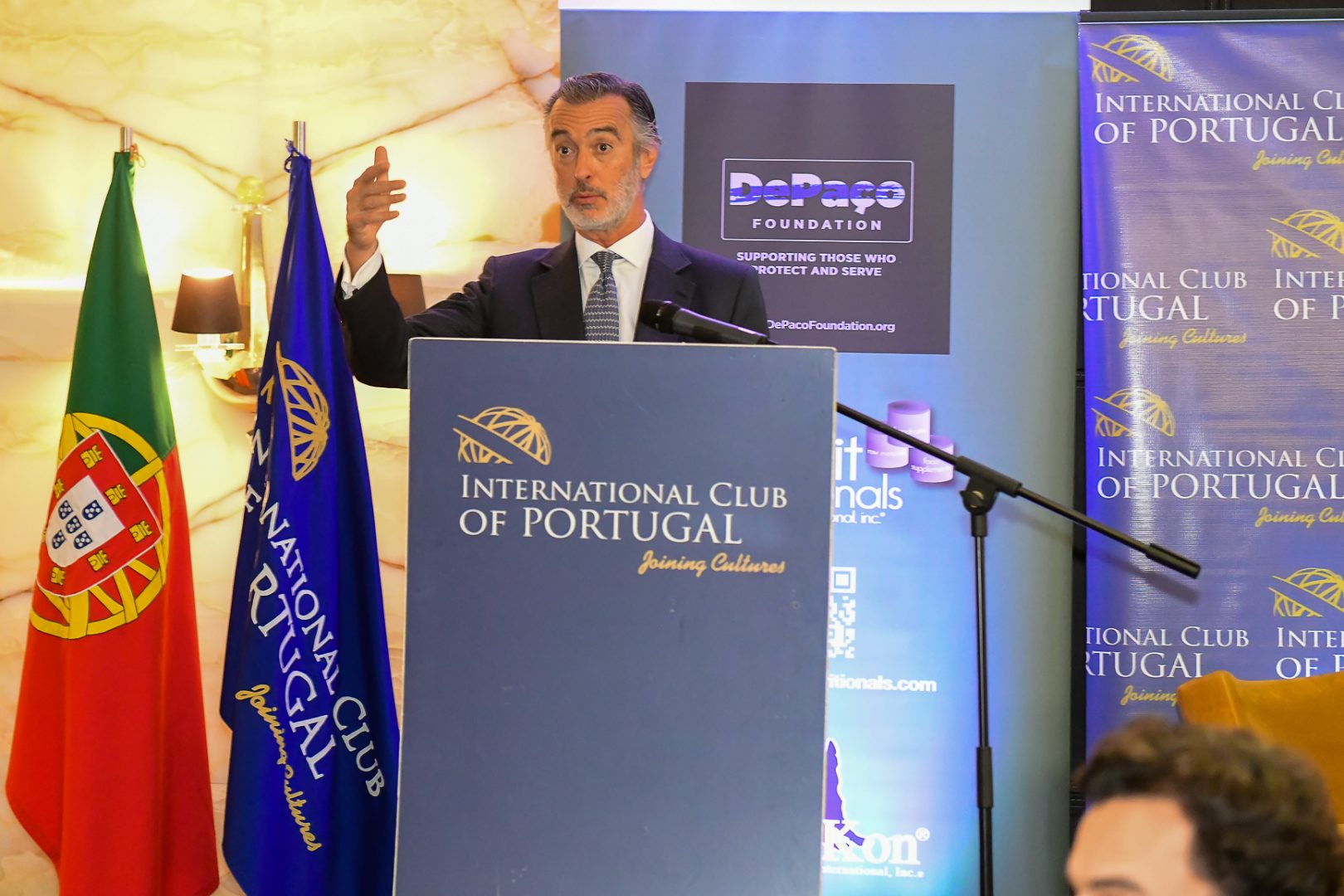
And one Portuguese who knows Portugal’s reputation and standing within the European Union, as well as the not so well perceived problems that have plagued the country for decades, such as poor productivity and a low-wage economy, is the entrepreneur and Portuguese politician and Euro MP João Cotrim de Figueiredo who addressed business leaders at a lunch organised by the International Club of Portugal (ICPT) on Wednesday, December 10.

Knowledge, Growth and Culture
João Cotrim de Figueiredo is one of the candidates for the Portuguese Presidential Elections in 2026 running on a campaign ticket with three main manifesto ideas: opening Portugal to investment for growth – a key factors for the future of Portugal’s success – defending knowledge, growth and culture, and strengthening Portugal’s democratic institutions, while conferring a maximum respect for the Supreme Commander of the Armed Forces.
On economic growth he said that while Portugal was still far from levels of 2021, Portugal had improved on 2012 with a forecast of 2.8% growth for 2025 depending on which accounts you believed in.
However, Cotrim de Figueiredo said that part of the growth – 1.5% – was down to the EU Recovery and Resilience Facility.
Portugal’s public debt is lower, he said, than had been, and will end the year at perhaps 96% of GDP, or even the same level as in 2024. “It was worse (in the past) and I’m not here to speak ill or do ill”, he said.
Portugal’s great problem with the economy was a lack of productivity standing at 75% of the European average which was the same as it had been in 1986 when Portugal joined the European Union.
“In 40 years we have had so much expenditure that we have not managed to get our productivity to converge (with the European average) and how are we going to achieve that?
“On the economy we have to be very hard, something very radical and different has to be done in order to increase productivity”, he said.

The problem of low salaries
And turning to salaries, which was part of and a result of the problem, was that they were “not sufficient”. “We’ve not succeeded in finding quality employment and what quality employment we do have costs us dear,” he said.
This, he explained, was a “structural problem” and until it was resolved, and while Portugal did not grasp the nature of its difficulty in increasing productivity and solving it, Portugal would not be able to pay better salaries and would continue to have a tragic situation with between 16,000 and 20,000 young Portuguese leaving Portugal while the retention of the most qualified had to be a priority.
Portugal had to get away from its historic employment model of low salaries and low added value.
The IL party candidate for the presidency said that the “system was being abused in as far as corruption in Portugal was on the rise, particularly in the National Health Service (SNS).
On the question of housing, João Cotrim de Figueiredo said that Portugal needed at least 500,000 new houses to help relieve the chronic housing shortage, and that over the past 14 years Lisbon had been building housing well below what the capital needed. Having said that, he admitted 2024-2025 had been the best year in over a decade for housebuilding with 24,000 new or refurbished homes.
Of course, Portugal’s productivity problem stems from a historical shift from manufacturing in the 1950s, 1960s and 1970s to less productive services, low investment in tech and R&D, labour market rigidity, to many smaller firms and not enough large ones, and structural issues like high taxes and state-owned firms, leading to lower output per worker compared to the EU average despite recent growth, as the economy struggles to transition to higher-value, knowledge-based sectors.

Government shouldn’t cave in to union pressure
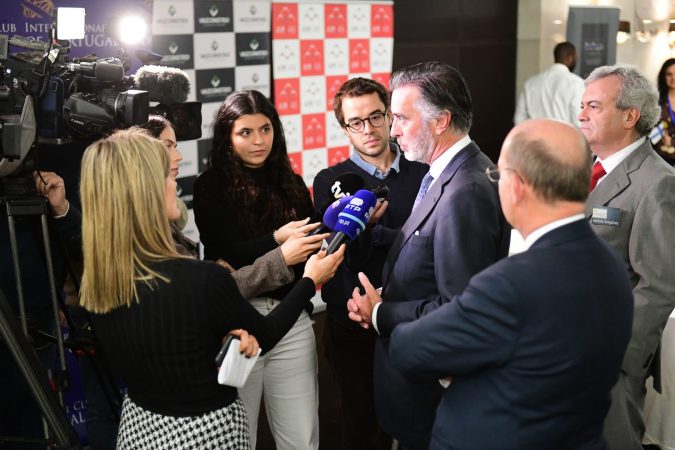
After the ICPT event, the candidate for the presidential elections challenged the government to avoid giving in to the general strike which took place the following day on Thursday, December 11 saying that the government could not back down art the first sign of pressure.
João Cotrim Figueiredo also said he was totally open to promulgating a revised labour package were he to win the presidential elections next year on January 18, despite having some reservations on some matters.
The candidate supported by the Liberal Initiative (Iniciativa Liberal) was quizzed on the possibility of the general strike being of such a magnitude that it would force the centre right coalition Democratic Alliance (AD) government led by Prime Minister Luís Montenegro to cave in and change its labour policy.
“A President of the Republic should not deal with a government that caves in to the first illusions and pressure”, and that if the government felt it was necessary to make radical changes to Portugal’s labour laws, then it should “advance to the point where it thinks it is reasonable”.

The General Strike – what all the fuss is about
Dozens of flights and trains were cancelled on Thursday, schools were closed and hospital operations were postponed across Portugal as the two main union federations staged the general strike over the government’s sweeping labour reforms.
Portugal’s Labour Law is about to undergo a major reform with over 100 proposed amendments to the Labour Code.
In September, the government presented its draft bill ‘Trabalho XXI’ aiming to modernise, increase flexibility and adapt the existing Labour Law to meet new social and economic demands.
One of the most significant changes in the new labour law is the extension of fixed-term contract durations. Fixed-term contracts may increase from 2 to 3 years, with a minimum initial duration of one year instead of the current 6 months.
Meanwhile, open-ended fixed-term contracts may be extended from 4 to 5 years. Additionally, the government intends to allow more situations where fixed-term contracts can be used, such as for long-term unemployed individuals or retirees due to age or disability.
Another key change is the return of the individual working hours bank, allowing employers and employees to agree on extending the working day by up to 2 additional hours, with a maximum of 150 hours per year.
Remote work is also addressed in the new labour law. The proposals aim to make it more flexible and clearer, adapting the legal framework to hybrid work models and ensuring proportional compensation for remote workdays.
The government also wants to remove a requirement to rehire employees who were unfairly dismissed, as well as lifting a ban on making employees redundant and then rehiring them as outsourced workers.
The government also wants to define the balance between remote and on-site work and allow temporary changes to the workplace, provided they are communicated at least 5 days in advance.
In terms of parental rights, the new labour law proposes that initial parental leave may extend up to six months, provided it is shared between both parents.
The parental allowance will be paid at 100% if parents choose to equally split the additional 60 days after the mandatory 120 days.
Moreover, parents may be required to take exclusive parental leave during the first 14 days after the child’s birth, instead of the current 7 days.
There are also changes to breastfeeding leave, which will be limited to 2 years and require a medical certificate renewed every six months. On the other hand, the government proposes eliminating the 3-day leave for gestational grief, meaning the other parent may have to rely on unpaid family assistance leave.
Continuous training is a key focus in the new labour law, with mandatory annual training hours of 20 hours for micro-enterprises and 40 hours for all other companies.
Under the new proposal, employees will be able to purchase up to 2 additional vacation days per year. This purchase will result in a corresponding salary deduction, but will not affect other benefits, such as attendance records or social security contributions.
The reform proposed by the Portuguese government represents an ambitious effort to update employment law in Portugal, aiming to increase flexibility and business competitiveness. The new labour law is still under negotiation with unions and social partners and must be approved by parliament.
Union opposition
But Portugal’s two main unions are opposed to the reforms and in the face of criticisms the government handed the main union UGT a new draft with some concessions, withdrawing, for example an amendment making it easier for bosses to make staff redundant in medium-size companies, but maintaining the return of the individual time bank or the repeal of the rule that provides for restrictions on outsourcing in the event of dismissal.
The CGTP has criticised the package as an assault on workers’ rights, particularly women and young people.
In turn, the UGT says that the reforms are out of step when Portugal’s economy is growing, when the country is financially stable, and there is high employment. It says that the changes show a clear bias towards company bosses to the detriment of employees.
The last time that the CGTP and UGT joined forces was during the eurozone debt crisis in 2013 when the ‘troika’ of international lenders effectively ran Portugal’s finances and proposed cuts in salaries and pensions as part of Portugal’s €70Bn plus bailout package financed by the IMF, ECB and EC.
There is some irony to the current general strike given that Portugal has become the fastest growing economy in the eurozone this year, but the current centre-right coalition government says that Portugal must tackle its rigid and inflexible labour market which is strangling productivity and competitiveness so that Portugal’s companies can become more profitable and lead to better salaries as a result.
And it is precisely why Joaquim Cotrim de Figueiredo in common with the other presidential candidates have become caught up in the presidential campaign with these controversial labour law changes with several candidates (not Mr. Figueiredo) claiming that the labour reform bill flouts Portugal’s 1976 constitution.
Under Portugal’s “semi-presidential” system, the head of state can decline to sign bills approved by parliament. Bills can instead be sent to the Constitutional Court for review or the president can exercise a veto that, while it can be overturned by a majority of elected MPs, delays the process, ensuring further discussion.
With the government seeking to overhaul so much of the labour code, such scrutiny might stoke voter unease about its radicalism, particularly since the plans were not in the coalition’s election manifesto.
Although Joaquim Cotrim de Figueiredo recognises that the process require negotiations and adjustments, he said “no one gets everything they want in a negotiation.”
The Euro MP also argued that the general lines of the new labour reform should be maintained because Portugal “needs legislation that can make hiring staff easier, shakeup and enhance employment creation and pave the way for higher salaries.”
The IL party leader also believes that the general strike provides an opportunity for the government to test “how genuinely representative the actual interests of the unions are” and to gauge to what point the labour reforms are backed by society as the government contests.
Cotrim de Figueiredo said he believed that the level of backing for the strike would influence the next round of negotiations between the government, company associations, and unions.
At the same time, João Cotrim Figueiredo also challenged his main opponent for the presidential elections on the centre right, lawyer and TV pundit Luís Marques Mendes to reveal the clients he represented as a lawyer when he worked for a well-known Lisbon law firm because the Portuguese had the right to know these interests, he argued.
The PSD party-supported Luís Marques Mendes had said in an interview with the news daily Observador that he was willing to reveal the clients of the family-run company that was wound up in November.
Cotrim de Figueiredo said the matter was “partly cleared up” but that Marques Mendes had only said he was open to revealing the clients represented by his family firm, but not those clients linked to his work at the law firm on grounds of confidentiality.