


The Future of AI: Are we on a driverless, runaway train with no guardrails or way of stopping it?
Whether we like it or not, Artificial Intelligence is here, and here to stay. There’s no way now of putting the genie back in the bottle.
But should we just sit back, relax and enjoy the ride and see where it takes us, or should some kind of regulation be put in place, and if that was possible, would it even work across borders?
When it comes to using AI, probably most of us use it on digital platforms and interfaces through applications such as ChatGPT.
And those who are in the IT business and are in the process of integrating AI in some way into their companies or business models, are probably already be using local models, assistants and agent workflows.
But how are companies investing in AI in terms of application layers or deeply integrating it into their specific sectors? Are they keeping it at the front line of specific generic applications?
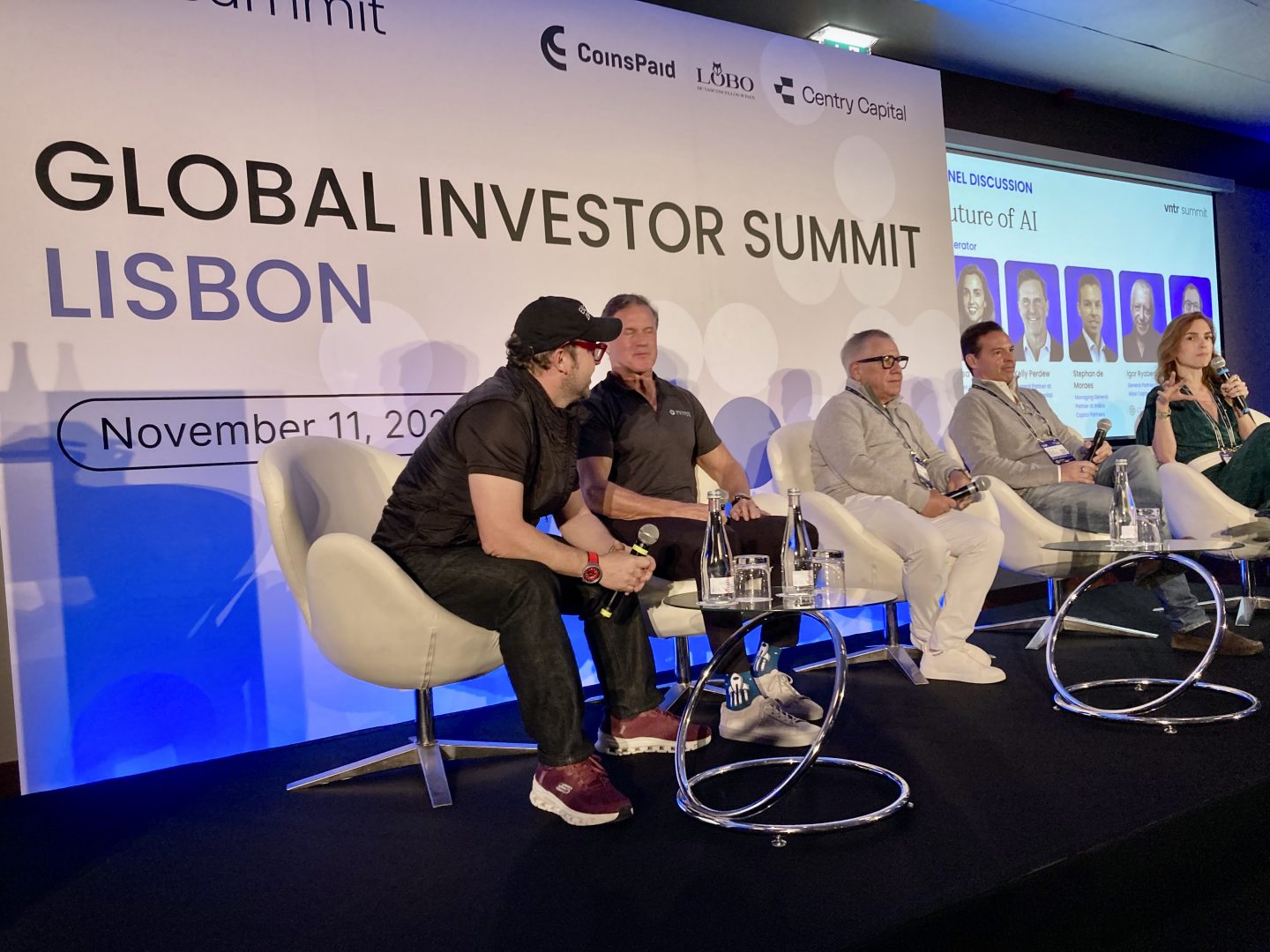
These were some of the questions and issues around AI discussed at the start of Web Summit week in Lisbon on Tuesday, November 11 at the 2nd VNTR Global Investor Summit held in Lisbon.
This was an exclusive, invitation-only get-together of investors, including VCs, family offices, and business angels and keynotes, panels and roundtables on trends like AI, Web3, and sustainable investment as well as fostering networking and co-investment opportunities among pre-qualified investors.
A revolution inside a revolution
Stephan de Morais, Managing Partner at Portuguese venture capital company Indico Capital Partners says Indico has been investing in AI for over a decade. “In fact one of our AI companies was taken over by Generative AI although that didn’t go well”, he admitted.
“I think there has been a ‘revolution inside a revolution’, and although this is very much case by case, the truth is that the foundational models and the most advanced infrastructure companies are and have been in the United States in the Western hemisphere.
Then we have China, which is obviously very, very advanced. In Europe, obviously we have companies like Lovable, which is impressive, and a few others. But we moved from thinking of generative AI as a ‘wrapper’ to a more sophisticated thesis in which the application will matter at some stage”, said Morais.
Although there are orchestration, financial models and cyber deep tech around AI, I see that was more in the US than in Europe. It’s way harder today to become a global tech champion than it was 10 years ago when we were in the age of SaaS, or 15 years ago when we were in mobile apps”, adds Morais.
The Managing Partner of Indico says that today the market is “way more competitive” and “a way deeper tech”. “It’s hard to say if you’re only gong to invest in infrastructure or cyber or apps”.
“It’s a case-by-case situation because you have to look all over Europe for companies that can actually compete at the global level. I wouldn’t choose specifically one area. If you do It has to be very, very specific. And you’re seeing from the (investment) rounds that some companies are attracting hundreds of millions of euros or dollars while others are not attracting anything, so it’s difficult to pinpoint”.
Tech developed today disrupted by tomorrow
Igor Ryabenkiy, General Partner at Altair Capital agreed and disagreed. “I agree that we need to address all levels and it is more difficult to find some players at early stage”, said the Altair founder who Invests in early stage projects and has had five funds.
He said that in investment you had to be very attentive because “many things being done today will be already disrupted tomorrow, either by LLMs (Large Language Models), or by models that come later. “See success and do it better because technology evolves very quickly.”
Kelly Perdew, General Partner at Moonshots Capital which invests in C-stage companies with a focus on leadership, and has made a lot of investments in AI-related companies despite being “tech sector agnostic” said: “I think Agentic AI is going to make a significant amount of applications obsolete, or that LLMs and hyperscalers are going to add most applications as a feature pretty quickly.
“Investing is really dangerous because you have to invest really fast on a app or it’s going to get ‘disintemediated” pretty quickly” warned the general partner of Moonshots which currently has a portfolio of 127 companies it has invested in with 30 successful exits, 18 of which are now unicorns.
Turning to cybersecurity. Cristobal Alonso, General Partner at Wolver Ventures which has made over 450+ investments over 13 years and has positively impacted 2,000+ founders, and has been doing a lot of investment in cybersecurity defence startups said he disagreed with the need to go “niche”.
“Actually, if you want to have an edge and to get the best founders you need to know your stuff and if you’re a generalist you don’t know it, or you have huge cheques.
He also warned that in AI and security the “bad guys are getting better than the good guys and they don’t care about regulations and so can improve all the time with the level of sophistication of attacks we see from Russia being enormous.”
Bringing in the right people was good but Europe could just as easily build great cybersecurity companies even with AI.
“What we have seen a lot of over the last two years is cyber technology teams becoming much smaller. Whereas companies had 10 people in the past, now they have two or three and yet they’re releasing (products) two or three times faster.
“The internal use of AI by technical teams is creating huge differences. At the same time there is no defensibility unless you have proprietary data models or you have huge access to data which for that you need to be integrated and selling that to enterprise, which I think is actually a huge difference”, he said.
Products could be built much faster and bypass existing ones. At the end of the day it was about execution and selling which was what all startups should bet about.
Could AI get out of human control?
But how resilient are these VC portfolios to Artificial General intelligence (AGI) which has the power to eventually surpass human intelligence?
“I personally don’t see this danger in the coming years at all, We see that despite new applications, we’re not seeing a lot of autonomous work, we still need a heavy human presence,” said Igor Ryabenkiy, General Partner at Altair Capital.
And added: “It could, yes. In an ideal world when applications start to create applications, when we give AI to finances, we could see all systems disrupted”.
Stephan de Morais of Indico Capital Partners believed that the sector had already arrived at a situation where advanced models were training other agents, but it still wasn’t out there.
“Of course the fear from a humanity point of view is that things get out of control. And I think it’s a well-founded fear because I’m not sure that the guardrails being put in are enough.
But the question is that you have many different blocs and companies developing these multiple layers of agents and you cannot stop this progress. I think we’re on the train and the train is moving very fast and we need to hope for the best once agents are really working”, he added.
The truth, he added, was that the vast majority of agent companies now don’t work very well. And this is also why you’re seeing a backlash with people distant from the industry saying: “actually AI doesn’t work”. So, it’s normal that there’s a hype and then there’s a bit of a backlash, but it’s here to stay.”
No one’s in charge!
The Indico founder says the models will improve quite fast as long as they have the right data and as long as they have the right cyber security around them.
“It is inevitable that we are going to have a very different world in a few years. But I think at the same time it will take a little bit longer than what we think in terms of actually making a huge difference in the vast majority of corporates” he added.
And in a more optimistic conclusion said: “We can talk about a lot of things – about big models and small models – but the truth is that in the current state of the world nobody’s in charge. The issue is that nobody knows what’s going to happen. And this is true at a political level and at the technology level. I think those visions of a future where a few people or a few big minds will be in charge of everything have not materialised.
The world is messy. Technology is super messy. It’s super exciting. It’s going to change the way we live. But I think that nobody’s in charge. And let’s just enjoy the ride,” conceded Stephan de Morais Managing Partner of Indico Capital Partners.
Postscript: It was reported by the Guardian on December 3 that humanity will have to decide by 2030 whether to take the “ultimate risk” of letting artificial intelligence systems train themselves to become more powerful, according to one of the world’s leading AI scientists.
Jared Kaplan, the chief scientist and co-owner of the $180bn (£135bn) US startup Anthropic, said a choice was looming about how much autonomy the systems should be given to evolve.
The move could trigger a beneficial “intelligence explosion” – or be the moment humans end up losing control.
In an interview about the intensely competitive race to reach artificial general intelligence (AGI) – sometimes called superintelligence – Kaplan urged international governments and society to engage in what he called “the biggest decision”.
The panel was moderated by: Alessa Berg, founder of Top Tier Impact.