


State Budget 2026 approved with abstention from Socialists
Portugal’s Budget for 2026 has been approved with abstention from the opposition PS Socialist party.
Voting for the budget were the PSD and CDS-PP governing parties with the other parties such as Chega, Liberal Initiative, Livre, PCP, Bloco de Esquerda, PAN and JPP parties voting against.
At the end of the debate, in statements to reporters, the Prime Minister acknowledged that the amendments to the document imposed by the opposition, which he described as an “à la carte auction of proposals”, “do not distort” the budget and estimated that they have a combined financial impact of “about €100 million”. Still, Luís Montenegro pointed out that “from the point of view of how the political system operates, unfortunately the two largest opposition parties decided to “invade the space” that belongs to the government”.
“More than the financial impact, they have made decisions that make governance inconsistent from the point of view of the administration,” he added, giving the example of the freezing of tuition fees or the abolition of tolls.
Compared to the original draft budget, the final approved documents had suffered no less than 63 changes over four days of debate picking over the details, 122 of which were presented by the opposition.
All told, 160 extras or alterations presented by the ruling coalition and the other parties were approved. From these 41 came from the PSD, CDS-PP, and 122 from opposition parties with 31 from the PS, 22 from the PCP, and 20 from Chega.
PAN managed to get 19 passed, Livre (17), BE (8) and IL (3) while JPP got 2.
Among the changes that generated the most tension were the end of tolls on the A6 and A2 motorways for residents and businesses, as well as the suspension of tolls for one year for heavy goods vehicles on the A41 CREP and the A19 motorway, on the section between São Jorge and Leiria Sul (A8/A19 junction) and the A8 between Leiria Sul (A8/A19 junction) and Pousos. The reinforcement of €1.6 million for the Constitutional Court, confirmed this morning, also marked the parliamentary debate, as well as the freezing of tuition fees by another so-called “negative coalition” to keep fees unchanged for the next academic year, against the government’s will.
Nevertheless, the government also won some victories such as overturning a proposal from the PS to increase pensions which, the Ministry of Finances had argued, would have put the current balanced budget into a deficit.
Instead, an “if things glow well” clause was added that promised an extraordinary pensions supplement if the budget execution and increased revenues allowed for it.
The Minister of State Reform, Gonçalo Matias, who is increasingly seen as either the power behind the throne or the poster boy for the ruling Democratic Alliance (AD), was chosen to round off the debate instead of the expected minister of Finance or Prime Minister.
And he was quick to criticise the rise of new “negative coalitions” from the opposition meaning the PS and Chega, pointing the finger at the PS for thinking that it could continue to govern from the opposition benches which was even worse given that it wasn’t now the largest opposition party.
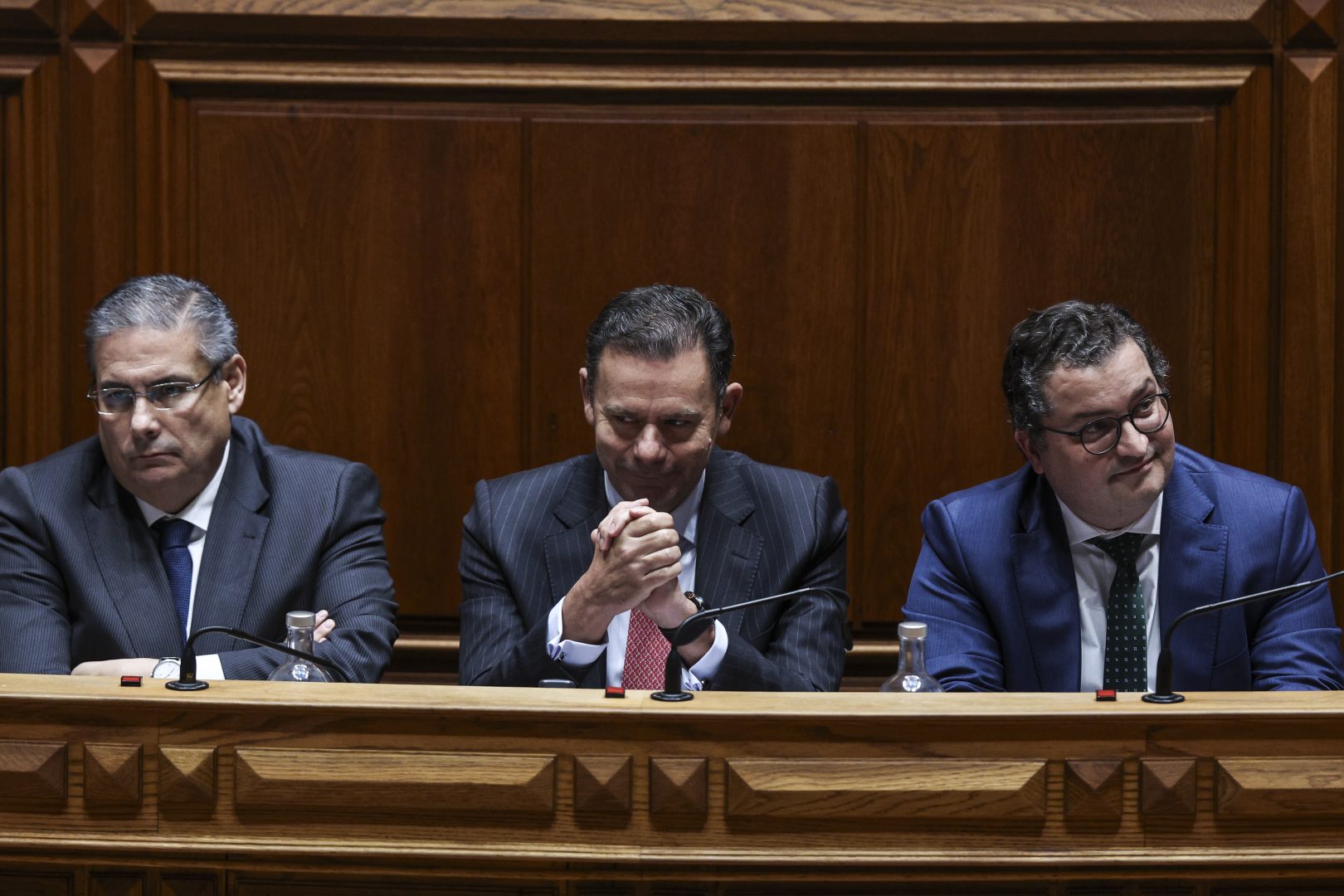
Image:
Prime Minister, Luís Montenegro (C), Minister of Parliamentary Affairs, Carlos Abreu Amorim (E), and the Minister of Finances, Joaquim Miranda Sarmento (D), during the final debate on the State Budget of 2026 (OE2026), at the Portuguese Parliament, in Lisbon, 27 November de 2025. TIAGO PETINGA/LUSA
Copyright: © 2025 LUSA – Agência de Notícias de Portugal, S.A.