


Embracing change: the future of innovation and technology as western tech dominance fades
Text: Chris Graeme; Photo: Web Summit
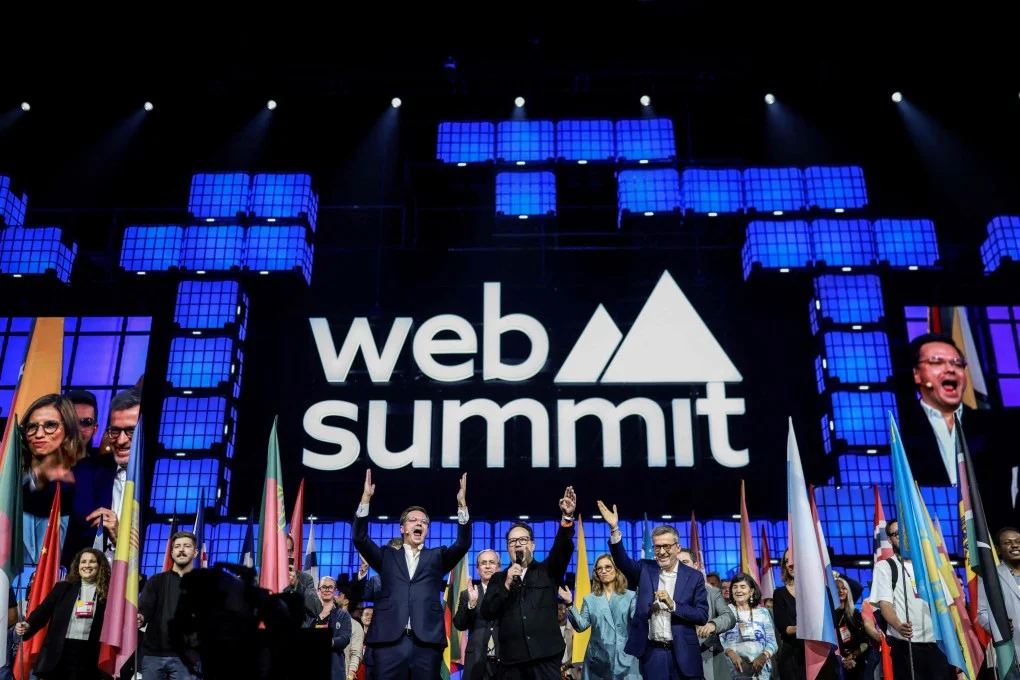
The opening to the 10th Web Summit in Lisbon on Monday evening was a homage to the success of startups all over the world, but it was also a warning that China was gaining the edge in areas such as artificial intelligence and a clarion call for Western Europe not to get left behind as Eastern Europe and Poland gain ascendency.
In true Olympic style, 100 startup champions from an equal number of countries paraded into the MEO Pavillion and onto the main stage, each proudly holding aloft their national flags, waving them to rapturous cheers.
Standing in line on stage under the hot glare of both spotlights and house lights, several of them were picked at random and asked what their startup was working on and its contribution to their ecosystems.
And the MEO area was literally packed to the rafters with 20,000 startup and other attendees; the kind of numbers you’d normally associate with a Madonna or Miley Cyrus concert. “Wow!” Exclaimed speaker Maria Sharapova. “I haven’t seen numbers like these since the US Open!”
As with all years, the summit was opened by Web Summit founder Paddy Cosgrave who immediately drew attention to a small three-man startup 10 years ago called Revolut – a British financial technology company that provides a digital banking app for managing money with its services including multi-currency accounts, international money transfers, spending cards, budgeting tools, and cryptocurrency exchange, all controlled through a smartphone app. “Today, Revolut has become Europe’s most valuable private tech company”, he said.
“It already felt like the world was changing fast back then, but it’s nothing like how fast it’s changing today”, said Cosgrave.
Chinese taking the lead in AI
So far, the Web Summit has been marked by the appearance of the most advanced humanoid robots in the world developed by the Chinese, an uncomfortable thought when you consider their eventual applications in the military with the prospect of huge robot armies tramping across Europe air covered by drones.
And as for those behind the world’s leading AI models, they too were at the summit, and these were almost always Chinese.
Unlike the companies Open AI or Anthropic, Chinese AI models are open source, meaning artificial intelligence systems that can be used, examined, altered and distributed for any purpose, without having to request permission.
These are free to use, and in the words of Nvidia’s CEO Jensen Huang, are likely to put China ahead of the US and Europe in the AI race.
This was something completely unimaginable 12 months ago. But there is more happening in the world than AI.
A revolution in payments systems
Money, they say, makes the world go round, and the world’s payments systems are on the cusp of being revolutionised. Not by an American tech company or by European central banks, but by an instant, real-time payment system from Brazil.
Called Pix, It allows for instant, 24/7 transfers between accounts at no cost to consumers, and is integrated into nearly every financial institution in the country. Pix has become the most popular payment method in Brazil, surpassing cash, credit, and debit cards due to its speed and convenience.
Pix is entirely free, and is so revolutionary that it has become the repeated target of US President Donald Trump in recent months because it will probably become the dominant payment system in the global south over the coming years and this poses a threat to current payment and fintech monopolies.
Western tech dominance fading
Paddy Cosgrave says that Web Summit used to be about a competition between Western tech companies and startups, but he notes that this year, more than any previous year, it is “clear that Western tech dominance is fading”.
And even in Europe, the centre of gravity and economic growth is shifting. “For the first yeast ever, the number of German startups at Web Summit has declined”, he noted.
The number of startups from Germany’s neighbor Poland is at a record high. “Poland, I would argue is becoming the poster child of a new Europe”, said Gosgrave.
“Motivated, ambitious, organised, as parts of Western Europe stagnate, Poland and Eastern Europe are accelerating.”
“We have startups from Qatar, the Middle East, Africa, Central Asia, India and Vietnam. I think that personally we have never lived in a more exciting moment,” he concludes.
Web Summit 2025: The Numbers Crunch
Web Summit 2025 joins 71,386 attendees from 157 countries.
1,857 investors are joining Web Summit 2025 from 86 countries, a 74% surge from last year’s 1,066. It is the largest number ever to attend the event.
2,725 startups, from 108 countries, will be exhibiting, with AI and machine learning emerging as the top industry. Notably, 40% of startups are women-founded.
Nearly 200 startups raised funding post-event: According to Crunchbase, nearly 200 startups from Web Summit’s 2024 Startup Programme secured post-event investment, with total funding reaching $715.5 million. You can read more about it here.
869 speakers join Web Summit’s stages this year, with Opening Night featuring leaders shaping the future of tech, business and culture, including the most followed person on TikTok Khaby Lame; Lovable, Co-founder and CEO Anton Osika; entrepreneur and tennis legend Maria Sharapova.
1,519 publishers, CEOs, editors and reporters, from outlets including The New York Times, The Wall Street Journal, CNBC, The Economist, Der Spiegel, Le Monde, Axios, CGTN, Globo, Sapo, Renascença, Valor Económico, RTP and Euronews are joining Web Summit to explore new technologies and ideas shaping the future.
268 government delegations are joining from 82 countries, including Portugal, Spain, Poland, Brazil, Spain, Angola, Germany, the US, Canada, Ireland, Austria, Japan, China, Belgium, India, Mexico, Qatar, Australia, and more.
400 curated meetups are underway, helping attendees make meaningful connections, from women in tech and backend developers to ai innovators, to a giant Jenga session.
Partners exhibiting at Web Summit include IBM, Visa, Qualcomm, Alibaba Cloud, Revolut People, KPMG, Replit, Huawei, and LinkedIn.