


Why management systems fail
For most of the post-war period, until the late 1990s, the typical management system was vertical and hierarchical – basically top down – an orders-based system leaving little input from the people who made up the company.
The CEO and top management defined the strategy, the middle managers were told to implement it, and the employees were told what to do by the middle mangers.
Nowhere was this more true than Portugal, a country today with only 16 top-drawer listed companies, around 600 large foreign-controlled companies (Just 2.5% of the total) – generating 67% of the country’s gross value added (GVA).
That leaves a large swathe of mostly small, often family-owned firms, many still with a paternalistic style of management and not much team playing, experimenting, and initiative taking going on except at senior management levels and beyond.
Redesigning leadership systems
Hugo Lourenço, the CEO of Agile Thinkers, a consultancy that believes in the human factors approach when designing equipment, activities, products, or systems, believes that the traditional model is a thing of the past, and that newer systems make it easier for people to do the right thing and hard to do the wrong thing in a corporate setting.
Hugo, who founded and organises the Management Summit, which this year took place at Lisbon’s FIL on Tuesday and Wednesday (September 23-24), says that most company teams fail not through lack of trying, but because of how leadership systems are designed.
“For 10 years we’ve tested, observed and corrected what doesn’t work in organisations to arrive at a principle lesson: frameworks alone don’t change anything. What changes everything is people; people who can decide under pressure, can collaborate when systems fail and adapt when uncertainty is the only certainty.”
The Lisbon Principles – thee principles of Value Creation
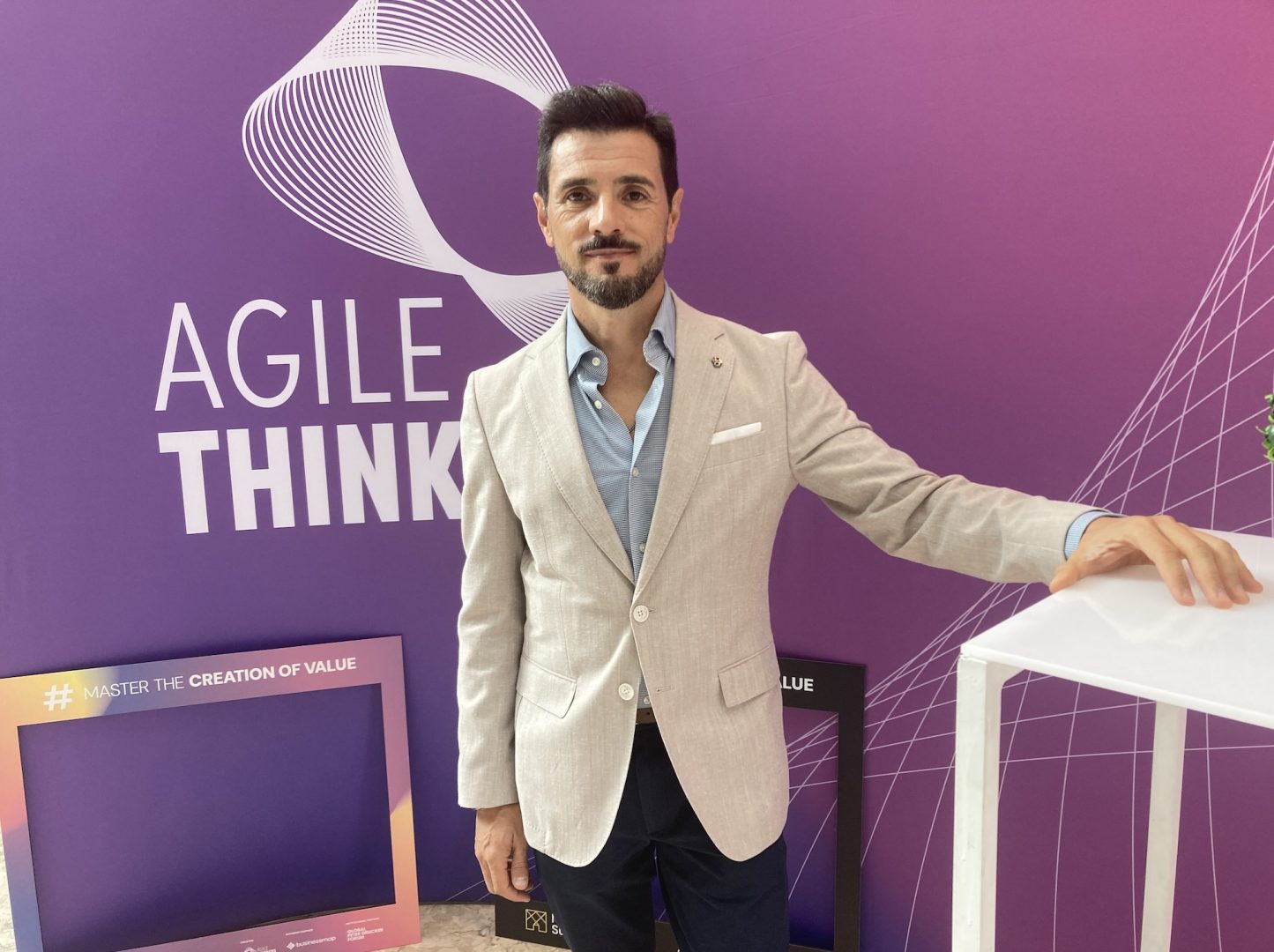
It was why Hugo (Pictured) created the Management summit 2025 as a working space for real leaders facing real challenges.
Hugo says that leadership is not about avoiding tension, and keeping people happy at all costs. It’s about pruning. Pruning what doesn’t work and scaling what does. It’s about creating value faster and more responsibly when the plan fails.
It all hinges on 3 Value Creation Principles: Focusing on customers and not profit chasing. This means prioritising real value for buyers rather than looking to making a fast buck and shifting from shareholder primacy to customer satisfaction. It also means embedding the customer into every strategy, operation and culture.
McKinsey studies show 20-30% growth from customer strategies, 49% faster profits, and 35% higher revenue via AI. Profit-chasing leads to burnout and 10-15% lower outputs; whereas customer-focused obsession builds loyalty and organic expansion.
The second principle is that autonomous networks crush hierarchies. Flexible teams tend to outmaneuver rigid command chains. If you replace top-down control with self-managing teams in networks of competence, you can get better outcomes. Hierarchies are stifled with bureaucracy, whereas networks deliver more than twice the financial performance through trust and rapid experimentation. (McKinsey)
The third principle of value creation is that adaptive mindsets demolish rigid routines. Fluid thinking adapts to chaos whereas mechanical processes shatter. In other words, it’s time to evolve from know-it-all leaders to learn-it-all facilitators who coach and inspire.
This cultural shift reduces management layers by 20-30%, enhances engagement, and ensures 50-60% more coaching. Without it, 40-70% of changes fail; with it, organisations thrive amid uncertainty and it is these three principles that create the people-friendly process and networks, as seen in evolving giants like Microsoft.
Hugo Lourenço explained that these Lisbon Principles, as he likes to call them, are about value – and value is adapted to culture and society, and what is seen as value in Portugal may not be the same as in the US or Asia.
“One thing we know is that value has to be about the wellbeing of people and that’s what we need to keep doing. Foster creativity, innovation, and ways of working and thinking, so that everyone feel appreciated when doing their job”.
Hugo says it’s a beginning of a declaration, moving from the bureaucratic and traditional top-down and reporting systems.
This goes as much for public companies and bodies and hierarchical military organisations as it does for companies. “Today we have people from the Portuguese armed forces, law enforcement agencies, NATO and the EU that can all benefit from this approach,” he says.
“So often the real intent of many companies is just to give money to the shareholders, whereas the mission of government administrators is very well defined – providing value and wellbeing for their citizens,” said Hugo.
“The question is do they have the motivation, curiosity and desire; can they try and challenge instead of looking only to vested interest, and just how many of those people in the bureaucracy create value?”
Hugo says that today’s entrepreneurs in Portugal do value creation really well because “they know that if they don’t apply them, at the end of the month they will not get any results.”
He points to unicorns and companies that were once startups like Tekever and Talkdesk as examples, but on the other hand he feels some companies are becoming too big or have grown too quickly such as Farfetch (which was bought out after expanding too fast and lost massive share value), Outsystems, or even Unbabel, which have come up against challenges, the latter having been recently sold on.
Portugal – very services orientated
Portugal, he says, is very orientated towards services. “Even our Finances minister (Joaquim Miranda Sarmento) has said that we are growing because of our services sector”, pointing to Lufthansa which has opened a (spare parts and maintenance) services company in Portugal.
“I think these startups, entrepreneurs, and small companies in Portugal that are trying to develop and sell products will obtain an advantage and they will show us how to lead an organisation.”
Ekjin Ilseven, a professor or Strategy and Organisation at Lisbon’s Católica University, says that regarding management in Portugal, “people are super nice and capable, and know how to solve problems. The question is how to you create incentives and systems to make the most of out this?”
“When I have conversations with high-level executives, all of them agree that Portugal has the talent and mentality, but there are some incentive problems, and I don’t know if there is consensus generally at a national level of where they want to go.”
Ekjin sees a lot of potential in Portugal too in terms of automation, but has discovered that a lot of people are still doing things in non-digital ways, or even when they do use digital, it’s just a twin of what they used to do on paper. “People are using Excel sheets but there is no automation in the digital algorithmic sense”.
And then there’s the question of how easy it is to invest in Portugal? I recently came across an example of an entrepreneur who wanted to open a factory here, but it took him two-and-a-half years to get a permit!”
Challenging the status quo
The CEO of pharmaceutical company Sanofi Portugal, Helena Freitas, said her mission was to “guide with clarity and promote autonomy” among her teams to make sure they are able to deliver the required results.
Helena gave the example of a pharmaceutical trade association whose board had done things the same way for 20 years and not always with the best results. She and 20 other GMs from different Pharma companies decided to step in and suggest that they needed to take a different approach to the healthcare ecosystem instead of the traditional way of doing things.
“In two weeks 20 GMs from different companies got together and held elections of the first time in 85 years – the results were fantastic and we got 40% of the votes and were able to challenge the status quo. For me, leadership means not only challenging the way things have always been done, but doing so permanently and in a safe way.”
Capitalism and democracy – flawed but achieves enormous things
Richard Straub of the Global Peter Drucker Forum*, said that in the post-war period there was a “feeling of optimism with a sense of progress and future” but now there was a “skepticism about innovation in Europe.”
“Today, you can feel an ambient pessimism, where we don’t feel we’re on the right path. There are so many things which are moving in a direction where people are either concerned or fearful. If you look at the geopolitical situation we have wars and an economic situation that is all but good for Europe.”
Straub said that over the past 200 years there had been a period of immense innovation and technological and human progress. It was a success story. “We’re not starting from a bad place, the question is how and where do we go from here?”
He pointed out that technological innovation and development had been driven by markets and that had been decisive because “without competitive markets we would have never achieved the level of innovation we have today”, and that was the story of the huge success of democratic capitalism.
Steve Denning, a former World Bank executive pointed to positive things happening in Europe on innovation and attitudes to it, and said when talking to Portuguese CEOs he has sensed “optimism and a drive to move forward and not to hold things back”.
Denning said that 80% of companies are still short-term profit driven and run in the same way they were decades ago. “They talk about the customer and all the wonderful things they are doing, but when push comes to shove they are mainly focused on short-term profit and shareholders.”
Management, he said, was a complex subject, with a number of ideas floating around, but how do they fit together?
Some ideas are drivers, some are results, and some are not that effective at all, but it’s about what is important in the organisation.
The Internet had enabled firms to create more value for customers and empowered customers who had more power to say what they wanted and choose which companies they wanted to deal with.
By 2008 companies like Google moved away from the hierarchical model of top-down organisation around a chart of boxes to adopt a completely new way of running their companies using autonomous teams with each team deciding on their focus, enabling the development of innovative ideas that sometimes turned out wrong, and others that turned out brilliantly.
“In fact they stopped recruiting people with management experience because they found that they infected creative thinking and started acting like they were in a pyramid of boxes”. This new approach may have looked like chaos and caused horror among management gurus, but it helped Google to grow.
“Today, Google is now worth US$3 trillion, so the traditional management experts were wrong and Google was right, and it’s a better way,” concluded Steve Denning.
About Management Summit 2025
In partnership with the Global Peter Drucker Forum, MS25 brought together some of the most influential voices in contemporary management. Among the speakers were Richard Straub, President of the Global Peter Drucker Forum, Steve Denning, former World Bank executive, Rita McGrath, professor at Columbia Business School, and national leaders such as Helena Freitas (Sanofi Portugal), Alexandre Ferreira (Fujitsu Portugal), Nathalie von Widdern (AstraZeneca Portugal), among others.
The leaders expressed that today, about 70% of corporate value comes from intangible assets such as trust, talent, or brand, but many companies continue to measure success through quarterly results.
Global Peter Drucker Forum – is an international management conference held annually in Vienna, Austria, dedicated to Peter Drucker’s philosophy and the evolution of modern management. It serves as a global platform for management practitioners, academics, and thinkers to exchange innovative ideas, address contemporary challenges, and foster a critical dialogue on the future of leadership and organisations. Often described as the “Davos of management,” it is known for its focus on themes like innovation, the future of knowledge work, and human-centric leadership in a rapidly changing world.
Image: Hugo Lourenço, the CEO of Agile Thinkers and founder of The Management Summit 2025. Photo: Chris Graeme.