


The Government wants to tackle red tape and corruption – let’s see how serious it really is
Opinion: Chris Graeme; Photos: Diana Quintela/MARE/AmCham Portugal
The Minister of Portugal ’s newly created Ministry of State Reform, Gonçalo Saraiva Matias, says that Portuguese companies are losing 750 hours per year to the country’s stifling red tape which is among the problems that lose Portugal investment, employment and waste its citizens time – and it has to change.
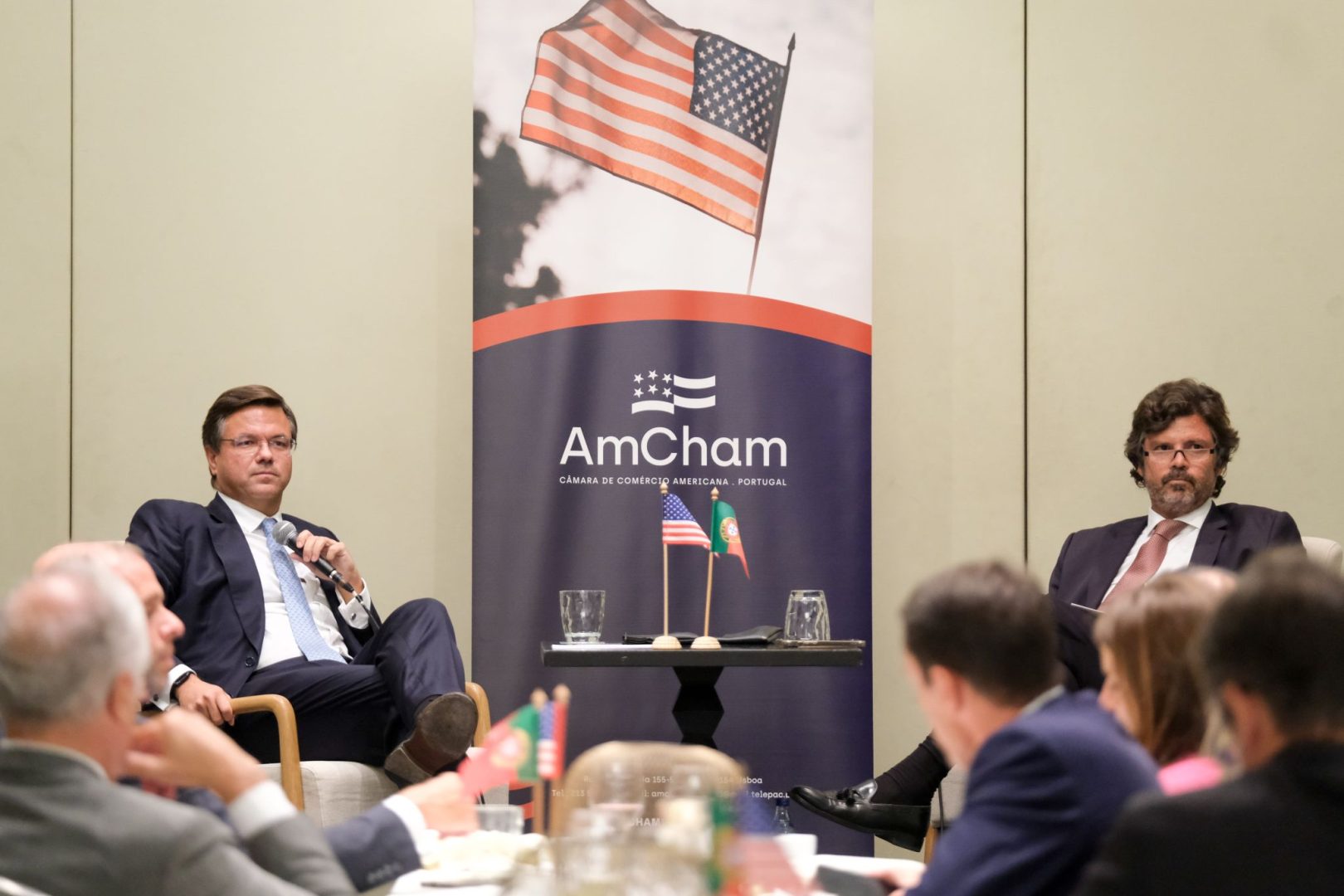
Noble and ambitious words from the government’s new Minister of State Reform, Gonçalo Saraiva Matias, speaking at a lunch organised by the American Chamber of Commerce in Portugal (AmCham Portugal) on Friday at the Sheraton Lisbon Hotel & Spa when the minister laid out the government’s stall for a top-down reform of the State centered around simplification, digitalisation, and streamlining services for Portugal’s citizens.
It was a path initially, if tentatively and painfully, embarked upon (encouraged by outside force) when the Troika of international lenders entered Portugal from 2011 when Portugal’s spiralling debt led to the intervention and suggestions for reform from the IMF, European Commission and European Central Bank to stave off default on the country’s loans in exchange for a €78Bn loan.
Improvements came, and the country’s finances were placed on a more solid footing, but the Troika lamented that Portugal needed to do better in cutting red tape and streamlining its bureaucracy.
It was followed eight years later on the tails of the Covid-19 pandemic, with a massive grant and loan injection of nearly €17Bn nicknamed the ‘bazooka’ by the Portuguese media, but was the Recovery and Resilience Fund which aimed to green up, digitize, digitalise, modernize and streamline Portugal’s public (and private sectors), and kick-start the economy through investment and export-orientated companies. So far, the EU has been generally satisfied with Portugal’s performance – but the red tape still persists and the suggestion is “could do better”, particularly when it comes to scaling up Portuguese companies to create symbiotic hubs to improve competitiveness, productivity and export potential.
So, it was a packed house for the lunch on Friday with expectations running high; a reflection of the gravity of Portugal’s sluggish, inefficient and highly bureaucratic public administration in nearly every sphere of public and commercial life – from property planning permission licensing and immigration to the fiscal system and justice – problems highlighted by this year’s Deloitte Tax Competitiveness Observatory, as even one senior PSD party stalwart, Luís Marques Mendes said recently that both Portugal’s two main centre political parties agreed that red tape had got worse over the past two decades despite some headway in simplifying and streamlining processes through digitalization and efficiency drives.
In fact, it has got so bad that the current Democratic Alliance government led by Luís Montenegro decided to create a whole new ministry to get things moving in the right direction – a bold move indeed, but still begging the question: ‘Is this only for the English to see?’ – to coin an old Portuguese phrase for ‘window dressing’.
“Every day we are losing investment, employment and wasting the time of our citizens and this has got to stop,” admitted the Deputy Prime Minister and Minister for State Reform, Gonçalo Saraiva Matias.
And Gonçalo Matias insisted that any attempts by the public administration – either managers or employees, to resist the necessary changes, or pretend they were changing things by merely tinkering around the edges, would be stamped out and added that across the board in the public administration and at all levels, State employees “recognised the need for, wanted, and were committed to real change”.
The minister highlighted the 750 hours were lost per year to bureaucracy, unlike Estonia which has zero.
He said that Portugal spent 43% of its GDP on financing the State apparatus (too high) but pointed out that on average the rest of the EU spent 49%.
Matias added that red tape was costing Portugal up to €10Bn a year, but that the strategy for tackling the problem was clear: first simplify, then digitalise, and ensure the interoperability between services, appointing the State’s first Chief Technology Officer (CTO), applying artificial intelligence in critical areas such as the aforementioned bugbear of licensing, while mobilising all players such as unions, companies, public entities, and civil society.
The minister said that “combatting bureaucracy is fighting corruption” but admitted that often times people resorted to backhanders because the system was so slow and cumbersome there was no other way of efficiently getting things done, not because they wanted to be corrupt for corruption’s sake.
Examples are legion – hotel projects that wait for up to four years to get planning permission, companies that want to relocate factories to Portugal but get bogged down in rules and regulations from both central and municipal governments, taxes that are so high (21%) and so complicated (and changeable from government to government) that investors almost need a PhD in Portuguese tax law to fathom the system. No wonder some head for Ireland where they pay 12.5%!
But, as Matias says, things would improve by “simplifying processes that would remove the incentives to corruption”. All valiant words, but the ‘proof of the pudding’, as we say in English, ‘is in the eating’. Let’s see how good things ‘taste’ five years down the road.
Photo: Moderator – Miguel Aires Antunes. (Photo by Diana Quintela/MARE|AmCham Portugal